Ford is not planning to build electric vehicles in the US with China’s Xiaomi, despite a report claiming the partnership would “pave the way for Chinese carmakers to gain a foothold in the US.”
Ford and Xiaomi have no plans to build EVs in the US
A Financial Times report over the weekend claimed Ford has held discussions with Xiaomi over a potential joint venture to manufacture EVs in the US, citing four people familiar with the matter.
Xiaomi denied the claims on Monday, saying the FT report is “completely false,” adding that it “does not sell its products and services in the United States and is not negotiating with any companies to do so.”
Ford also denied the report, saying, “This story is completely false. There is no truth to it.” The rumors come after a Wall Street Journal report last month claimed that Ford was in talks with BYD to import batteries for its hybrid vehicles for sale outside the US.
According to the FT, however, Ford has held talks with BYD and other Chinese carmakers about partnerships in the US.
This report about a joint venture with Ford Motor Company is completely false. Xiaomi does not sell its products and services in the United States and is not negotiating with any companies to do so.https://t.co/fc0C2IEtN7
— Xiaomi (@Xiaomi) February 2, 2026
Representative John Moolenaar told the FT that Ford would “be turning its back on American and allied partners, and it will make our country further dependent on China.”
Ford is already on track to begin manufacturing lithium iron phosphate (LFP) batteries at a new $3.5 billion plant in Michigan this year, using licensed tech from China’s CATL.
The facility will supply batteries for vehicles based on Ford’s low-cost Universal EV Platform, beginning with a midsize electric pickup priced around $30,000.
Electrek’s Take
Chinese EV makers, such as BYD and Xiaomi, are winning over buyers with more efficient, more advanced, and more affordable electric vehicles.
BYD already accounts for about 70% of electric and hybrid vehicle sales in Mexico, and a new trade deal between China and Mexico opens the door for it to enter another North American market. The company is stealing market share from global OEMs in Europe, the UK, Australia, Southeast Asia, and several other regions.
Meanwhile, America’s “Big Three” Ford, GM, and Stellantis continue scaling back major EV initiatives, putting them even further behind.
The Trump Administration’s killing off the $7,500 federal EV tax credit and other policies designed to promote adoption have given China an advantage in global markets, and it’s showing. Ford announced in December that it would take about a $19.5 billion hit, most of which was due to cancelled EVs.
As the US dials back, BYD, Xiaomi, CATL, and other Chinese leaders are pushing ahead with new battery types, powertrain tech, ultra-fast chargers, smart in-vehicle tech, and more.
Ford’s CEO Jim Farley has warned several times that Chinese EV makers pose an “existential threat” to Western brands, including itself.
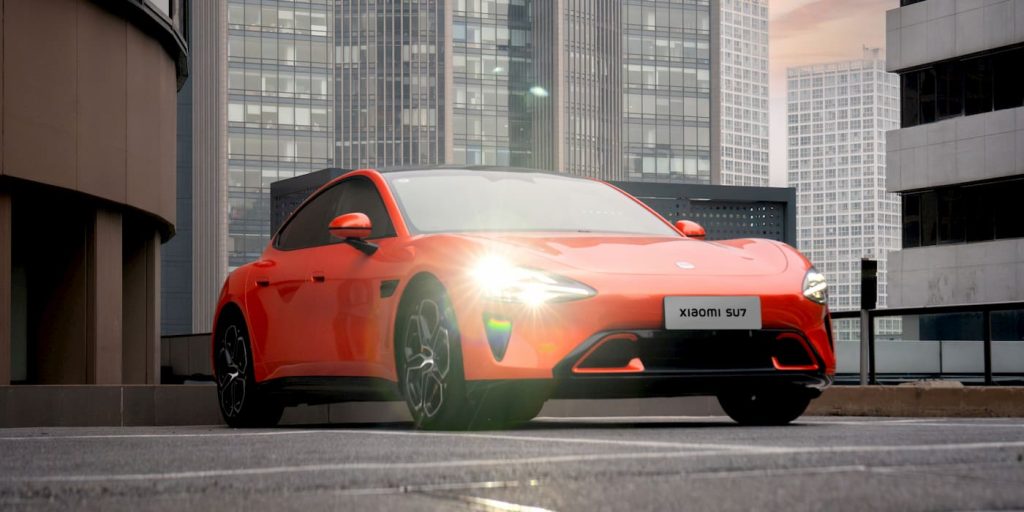
After flying Xiaomi’s first self-developed EV, the SU7, from Shanghai to Chicago and driving it around for six months, Farley even admitted he didn’t want to give it up, calling the company “an industry juggernaut.”


FTC: We use income earning auto affiliate links. More.