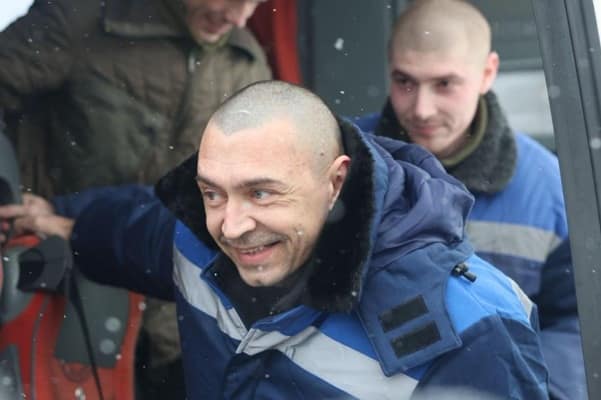
Thursday’s prisoner exchange was, without question, a good day.
In the 71st such swap since the start of the full-scale invasion, 314 prisoners of war were exchanged, 157 from each side.
Of the Ukrainians who returned home, 150 were servicemen and seven were civilians: soldiers, sergeants, officers, and border guards from the Armed Forces, the National Guard, and the State Border Service.
Many had been held since 2022, when Russia expanded its war after February 24. Among them were men from my own Marine company.
One of those freed was Marine Praporshchik (Warrant Officer) Eskender Kudusov, a Crimean Tatar Ukrainian marine.
Through the Russian occupation authorities’ so-called “court” system, Kudusov was first sentenced in 2023 to 25 years in prison. In October 2025, that sentence was increased to 29 years and six months. Human rights groups and Ukrainian sources have described the process as unlawful and politically motivated, part of a broader pattern in which Russian and occupation courts fabricate charges and impose extreme sentences on Ukrainian prisoners of war, in direct violation of international humanitarian law.
Putin is abusing INTERPOL to ‘pursue critics’ such as journalists and those connected to Ukraine
This practice is not unusual because I know it personally. In 2022, I was given a death sentence by a puppet court recognised by only a handful of states, Russia among them, but men and women walked free yesterday who should never have been imprisoned in the first place. Families were reunited, and for a few hours, the noise of geopolitics gave way to something simpler and far more important: people coming home and rarer these days, hapiness.
But it would be a mistake, an understandable one, but a mistake nonetheless, to measure these exchanges as proof of diplomatic progress, or worse, as evidence that a broader peace process is somehow “working.”
Prisoner swaps are not new, they did not begin in Abu Dhabi & they did not begin in 2022. They have been a grim, necessary feature of this war since 2014, and they exist for one reason only: because there are prisoners in the first place.
Right now, there is a growing temptation in some political and media circles to fold everything into the same narrative basket. Talks happen somewhere, a deal is announced and a prisoner exchange follows. Therefore, the logic goes, “the process” is moving.
Prisoner exchange has taken place – 157 Ukrainians for 157 Russians. pic.twitter.com/m4zqKzqPYw
— Saint Javelin (@saintjavelin) February 5, 2026
But exchanges are not a by-product of peace, however, they are a by-product of war, a war Russia is still prosecuting every single day.
They are humanitarian pressure valves in an otherwise brutal system, one I experienced firsthand. Long before you ever reach a sham courtroom, you are already subjected to a different kind of trial: isolation, coercion, endless interrogations, and the steady attempt to break your sense of self by electrocuting or beating you. By the time the sentence is finally read out, it rarely comes as a surprise. Torture and pressure are effective tools for extracting confessions to things you have never done and places you have never been. The paperwork that follows is simply the final act of a performance designed for propaganda — to justify tomorrow’s narrative.
Many of those freed this week, after years in captivity, will now need time, care, and serious support to find themselves again.
For Ukraine, for Russia, and most of all for the families waiting at home, these swaps are about people, not optics. They are about getting someone back from a cell, a camp, or a forgotten corner of a brutal Russian prison system, and putting them back into the arms of those who have spent months or years living in a kind of suspended animation.
And that suspension is something few outside the experience truly understand.
Many of the men who came home yesterday will have lived for years with little to no reliable information from the outside world. In some cases, for nearly four years or more. What news they did receive will almost certainly have been filtered, distorted, or outright fabricated by the Russian state system. Time doesn’t move normally in captivity. It stretches, compresses, and warps into the same monotonous day, blending into the next like a real-time Groundhog Day. Seasons pass, but the world beyond the walls becomes distant and half-imagined.
Hope, a word so undervalued in military terms, becomes your most valuable weapon. When everything is stripped from you and every ounce of humanity is being drained away, sometimes hope is all you have left.
For years, some of these men lived in horrendous conditions. Many, like myself, were kept underground in 3m x 1m spaces barely fit for storage, let alone human beings. While we were gone, people died, family members, friends. Moments that can’t be replayed or recovered. That is something many of those freed yesterday will now be discovering in the hardest way possible.
The joy of release is however is real, but it is often followed by a strange, hollow impact, like running headfirst into a wall you couldn’t see coming. It can take a week, a month, a year, but it comes. There is a moment, after the cameras, after the embraces, after the first hot meal, when the question arrives quietly:
What now?
That question doesn’t mean they aren’t grateful or aren’t relieved. It means they are human.
Captivity freezes your life but the world does not freeze with you. Children grow up, parents age, relationships change or fracture & entire cities have been reshaped by war. You return not to the moment you left, but to a future that kept moving without you. For some, that adjustment will be harder than anyone expects.
At the same time, there is no mistaking the sensory shock of freedom. New tastes, new sounds, the simple, almost absurd luxury of choosing when to sleep, what to eat, where to walk. These are things most people barely notice, but for someone who has been locked away, they can feel overwhelming, even unreal. For me, it was sensory overload, as if you could feel, smell, touch, and see everything all at once. Even rain and wind are things you forget behind concrete walls and prison doors. For sixty days, I did not see the sun. Freedom is a physical and psychological re-learning process, and one that stays with you forever. This is why it is so important not to instrumentalise prisoner exchanges for political storytelling.
Since 2014, exchanges have happened under wildly different conditions: during active fighting, during supposed “ceasefires,” during failed negotiations, during moments of escalation, and during periods of relative quiet. That doesn’t make the system humane, it makes it necessary.
Some will inevitably try to link yesterday’s exchange to talks elsewhere, to suggest a neat cause-and-effect relationship, but that framing misses the point. Prisoner swaps are not confidence-building measures on the road to peace, they are damage control in a war that is still very much alive.
If anything, they underline how far we still are from anything resembling a structured, durable settlement. A real peace process doesn’t just trade people back and forth while the machinery of war keeps grinding. A real peace process deals with security guarantees that actually mean something. It deals with borders, accountability, reconstruction, and the brutal question of how you stop this from happening again. None of that is solved by an exchange, however welcome that exchange may be.
For the men who came home yesterday, politics will come later, if it comes at all. First comes medical checks and debriefs, then rest & rehabilitation. Then the slow, often messy process of reconnecting with families and with a country that has changed while they were gone. Some will want silence, some will want noise and company. Many will want to talk and fill in the gaps in their lives, while probably absolutely all of them, heartbreakingly, will now be told who made it home, and who didn’t.
We should celebrate them being home and support them on the long road back to something resembling ordinary life. They should be proud of what they endured and what they stood for. Ukraine should remember that without people like them, this country would almost certainly already be an imperial conquest. But the human cost of this war is visible again, not as numbers on a screen, but as faces stepping off buses. For the families, they can begin to heal and for some, the suffering in captivity has finally ended.
Until there is a peace that is more than a pause, more than a photo opportunity, and more than a diplomatic talking point, there will be more prisoners, more lists and more negotiations over human beings with more families, waiting by phones that do not ring.
So yesterday was a good day, it really was, but it was a good day inside a bad, unfinished story still yet to unfold, while the men who came home are now beginning a new chapter that will be harder, stranger, and more complicated than most people realise.
One where freedom is real, but the past doesn’t stay neatly behind the door they just walked through.
Slava Ukraine!!