[ad_1]
Iran has warned of “severe” consequences for American military vessels attempting to pass through the Strait of Hormuz, dramatically escalating tensions following the collapse of peace talks with Washington.
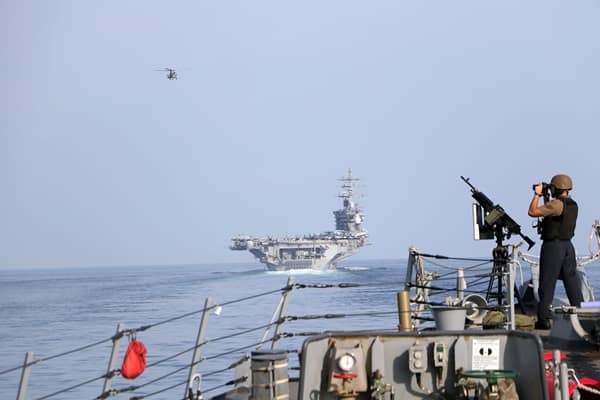
The threat, issued by the Islamic Revolutionary Guard Corps (IRGC), came after US warships entered the strategic waterway to begin clearing mines laid by Iranian forces.
In a statement carried by state broadcaster IRIB, the IRGC Navy Command said: “Any attempt by military vessels to pass through the Strait of Hormuz will be dealt with severely.”
Tehran insisted its naval forces retain full authority over the passage, adding that only civilian vessels meeting “specific conditions” would be permitted to transit the route — a vital artery for global energy supplies.
The confrontation follows the abrupt breakdown of negotiations between the United States and Iran in Islamabad, after 21 hours of talks failed to produce an agreement.
JD Vance, who led the American delegation, admitted the effort had fallen short, blaming Tehran for rejecting Washington’s terms.
“The bad news is that we have not reached an agreement,” he said, adding that Iran had “chosen not to accept” US conditions.
Iranian officials, however, accused Washington of making “excessive” demands, with state-linked media claiming American “overreach” had derailed what were described as “intense” negotiations.
The standoff has rapidly spilled into military posturing. US Central Command confirmed it has deployed underwater drones and additional naval assets to clear the strait and “establish a new passage” to safeguard commercial shipping.
Admiral Brad Cooper said efforts were underway to ensure the continued “free flow of commerce” through one of the world’s most critical maritime chokepoints.
The Strait of Hormuz carries roughly a fifth of global oil and gas supplies, making any disruption immediately felt across international energy markets. Prices have already surged since Iran’s initial blockade, fuelling fears of wider economic fallout.
Donald Trump has sought to project confidence, insisting the United States would secure the reopening of the route.
Calling it a “favour to countries all over the world”, he said Washington would act on behalf of allies including China, Japan and Germany, while criticising others for lacking the “courage or will” to intervene.
Earlier, Mr Trump had tied a temporary ceasefire to Iran agreeing to the “complete, immediate, and safe opening” of the strait — a condition that now appears increasingly uncertain.
Further inflaming tensions, Iranian officials have proposed levying a fee on vessels passing through the waterway, with reports suggesting a charge of $1 per barrel and mandatory disclosure of cargo details — a move likely to provoke further confrontation.
With diplomacy stalled and military forces manoeuvring in close proximity, the risk of escalation in the Gulf is rising sharply, threatening not only regional stability but the flow of energy on which the global economy depends.
[ad_2]
Source link