Electric boats and ferries are starting to become more common, but they have typically been confined to short, fixed routes with expensive, purpose-built charging infrastructure. This week, Swedish electric boat maker Candela set out to prove that those limits are no longer necessary – and did so in record-setting fashion.
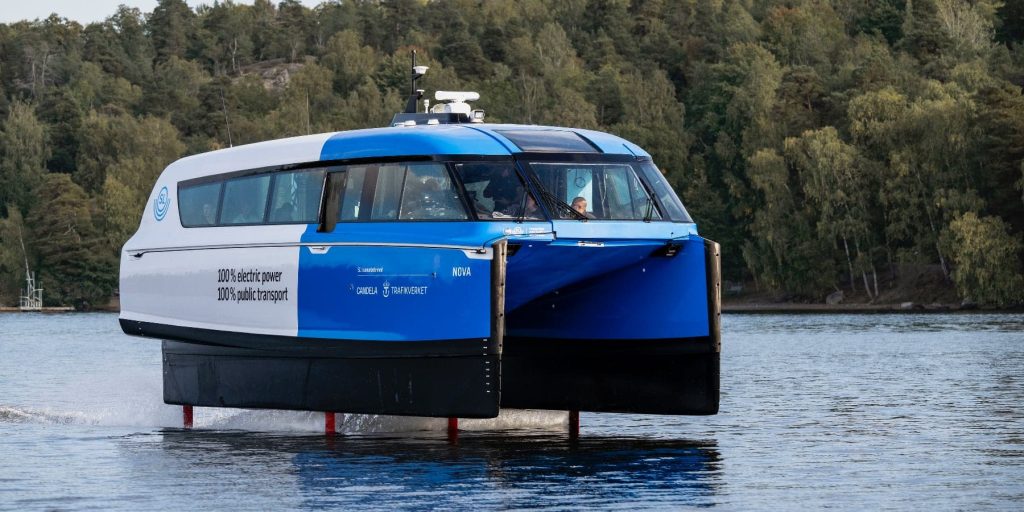
Candela’s P-12, the world’s first serial-production electric hydrofoiling passenger ferry, has completed what the company tells us is the longest electric sea journey ever made by an electric passenger vessel. The 160-nautical-mile voyage saw the ferry travel from Gothenburg on Sweden’s west coast to Oslo, Norway, over the course of three days.
What makes Candela unique is its use of hydrofoil technology. Beneath the hull, computer-controlled submerged wings lift the vessel out of the water once it reaches speed. That dramatically reduces drag and cuts energy consumption by around 80% compared to conventional displacement boats. The result is an electric vessel that can travel faster and farther using far less energy and on a smaller battery, further cutting costs and reducing charge times.
The Candela P-12 cruises at 25 knots, has exceeded 30 knots in testing, and can travel up to 40 nautical miles at speed on a single charge. It’s already operating in Stockholm’s public transit system and holds the title of the fastest electric passenger vessel currently in service.
The Norway trip was designed to highlight just how different that efficiency makes real-world operations. In Oslo, the fastest conventional electric passenger ferry runs a fixed 10-nautical-mile route and depends on swapping multi-megawatt-hour battery containers at each stop – an infrastructure system that has cost hundreds of millions of Norwegian kroner and limited route flexibility.
By contrast, the Candela P-12 charges using standard DC fast chargers. Along the journey, it plugged into existing fast-charging stations where available to recharge in around one hour, and when they weren’t, it used a portable 360 kW DC charger powered by a mobile battery system – towed behind a Ford F-150 Lightning electric pickup. That meant no megawatt-scale dock installations were required.
The entire 160-nautical-mile journey consumed just over €200 worth of electricity (roughly US $230).
“Charging infrastructure is the hidden cost of electrifying conventional vessels,” said Gabriele De Mattia, project engineer at Candela and lead engineer for the record-setting voyage. “In many cases, building megawatt-scale chargers – especially where the grid is weak or undeveloped – can cost as much as the vessels themselves. The breakthrough with P-12 is that it is fast to charge and extremely flexible in where it can operate.”
Electrek’s Take
Each time a Candela story comes across my desk, it’s fun to see what new record the company has broken this time. From longest distance in 24 hours to longest voyages (yet!), these awesome electric boats keep rewriting what is possible and showing that electric vessels don’t have to be slow or range-limited. They may not be making ocean passages yet, but they’re perfectly capable of swapping the thousands and thousands of everyday ferries out there burning diesel and pumping poisons into our air and water.
I just love watching Candela’s electric ferry continue to push new limits and show that electrifying waterways doesn’t have to mean massive infrastructure projects and rigid routes. With hydrofoils dramatically cutting energy use, electric passenger vessels are becoming faster, cheaper to operate, and far more flexible. After this trip, it’s hard to argue that long-distance electric ferries are still a future concept. In fact, Candela just sailed one into the present.


FTC: We use income earning auto affiliate links. More.