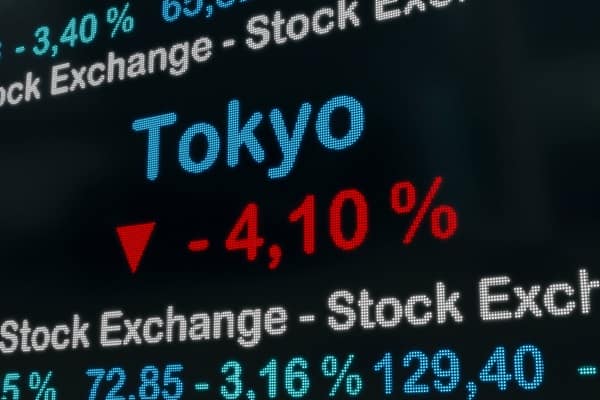
Prime Minister Sanae Takaichi’s October confirmation triggered immediate volatility across Japanese markets. Long-term bond yields reached multi-year highs, the yen fell past the 150-per-dollar threshold, and equity indices climbed to record territory. Her public calls for looser monetary policy clashed with market expectations, forcing some investors to recalibrate their assumptions about the Bank of Japan’s next moves.
The turbulence reflects deeper pressures reshaping Japan’s corporate funding environment. Borrowing costs are climbing as the Bank of Japan inches toward policy normalization, having exited negative rates in 2024 and raised its benchmark to 0.5% earlier this year.
Meanwhile, export-dependent manufacturers face mounting headwinds from U.S. tariffs, with July exports posting their steepest decline in four years. Factory activity has contracted for six consecutive months through September.
Japanese equities holdings remain a largely untapped potential source of liquidity that could provide funding flexibility to navigate this new environment.
EquitiesFirst operates in this market, providing financing secured by equity holdings across Asian markets. The firm’s model provides access to capital financed against existing shareholdings. It represents one segment of the broader private credit expansion occurring as companies seek alternatives to conventional debt markets.
Rising yields squeeze traditional funding channels
Takaichi’s advocacy for fiscal expansion and reluctance to embrace further rate hikes has created uncertainty about Japan’s debt trajectory. The 30-year government bond yield hit 3.345% in October, its highest level since the security’s 1999 debut, as investors priced in fiscal risks. Amundi Investment Institute projects the yield could climb above 3.5% in coming months if Takaichi pursues aggressive spending without clear financing mechanisms.
Higher sovereign yields flow through to corporate borrowing costs. Companies that relied on near-zero interest rates for years now confront a different calculus. Meanwhile, bank lending remains relatively conservative, particularly for mid-sized firms lacking investment-grade ratings. The Bank of Japan’s gradual policy normalization, with some analysts forecasting another rate increase to 0.75% by year-end or early 2026, has signalled continued upward pressure on funding costs.
Rising debt service costs compress operating margins, especially for capital-intensive manufacturers already struggling with weak export demand. Refinancing existing obligations at higher rates further strains balance sheets, limiting capacity for growth investments or operational flexibility.
Private credit markets are expanding to fill gaps left by traditional lenders. Assets of non-banking financial institutions have grown steadily, with credit providers other than pension funds and insurance corporations showing particularly robust gains. Japan-based investors allocating to alternatives including private credit grew by over 50% in the five-year period ending 2024, according to Preqin.
EquitiesFirst operates within this broader credit expansion, providing liquidity financed against publicly traded shares.
Export pressures compound funding needs
Japan’s export sector is currently facing one of its most challenging environments in years. U.S. tariffs imposed in April at 25% on automobiles and auto parts have hit major OEMs particularly hard, with exports to America—Japan’s largest market—declining 10.1% year-over-year in July. Although a July trade agreement reduced rates to 15%, the tariff burden remains substantially higher than the pre-2025 baseline of 2.5%.
Automotive manufacturers have absorbed some costs through price cuts and operational efficiencies to preserve volume, but margins have compressed significantly. Beyond autos, machinery and semiconductor equipment makers face intensifying competition from Korean and Chinese producers. Factory purchasing managers’ indices have remained in contraction territory, with September’s reading of 48.4 marking the fastest decline in six months.
These trade headwinds are intersecting with the higher interest rate environment to create a capital squeeze. Export-focused firms need funding for product development, supply chain adjustments, and potential geographic diversification, yet their ability to service new debt is constrained by weakening revenue growth and uncertainty surrounding global economic policy. Traditional bank lenders have grown more conservative in underwriting, particularly for sectors directly exposed to U.S. tariff policies.
Monetary policy uncertainty and capital flexibility
The path of Japanese monetary policy remains uncertain despite the Bank of Japan’s stated commitment to gradual normalization. Takaichi’s October statements emphasizing the importance of wage growth alongside price stability suggest continued government pressure for accommodative policy.
She specifically requested that the central bank pursue inflation “driven not just by cost-push factors, but accompanied by wage gains.”
Her administration has refrained from revising the 2013 joint government-BOJ agreement focused on ending deflation, acknowledging that economic conditions have evolved. Rising living costs have replaced deflation as the primary policy concern. Any future coordination between fiscal and monetary authorities will likely centre on balancing growth support against inflation management.
Market participants expect the BOJ to raise rates again by early 2026, with the benchmark potentially reaching 1% by summer according to former central bank officials. Each incremental increase tightens financial conditions for leveraged corporations, particularly those facing revenue headwinds from trade disruptions or weak domestic demand.
In a climate where conventional lending tightens and export visibility dims, share-backed financing models such as EquitiesFirst’s may emerge as a pragmatic tool for Japanese firms seeking stability without sacrificing ownership.