
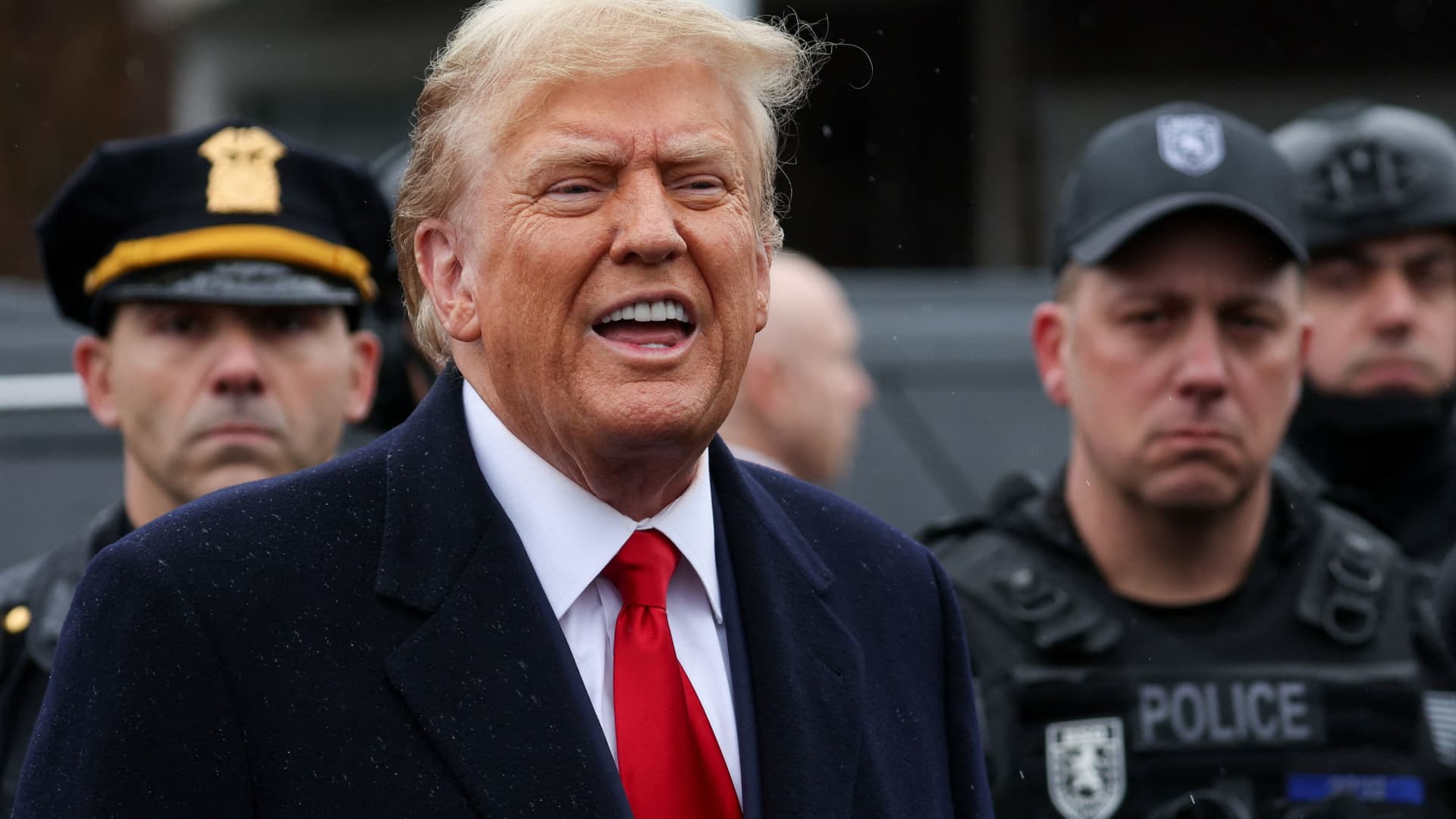
Former U.S. President Donald Trump speaks after attending a wake for New York City Police Department (NYPD) officer Jonathan Diller, who was shot and killed while making a routine traffic stop on March 25 in the Far Rockaway section of Queens, in Massapequa Park, New York, U.S., March 28, 2024.
Shannon Stapleton | Reuters
Decades of trade deficits and a strong dollar created too many “losers” in the U.S. economy who turned to Donald Trump’s protectionist policies, according to Richard Koo, chief economist at the Nomura Research Institute — and those conditions remain.
Trump’s “America First” economic policies led his administration to institute a slew of trade tariffs on China, Mexico, the European Union and others, including slapping 25% duties on imported steel and aluminum.
As the Republican nominee for the 2024 presidential election, Trump has proposed a baseline 10% tariff on all U.S. imports and a minimum levy of 60% on imported Chinese products.
These policies have drawn widespread criticism from economists, who argue that tariffs are counterproductive, as they make imported goods more expensive for the average American.
Speaking to CNBC’s Steve Sedgwick on the sidelines of the Ambrosetti Forum on Friday, Koo said protectionism was a “horrible thing,” but that Trump’s approach “does have some economic logic.”
“When we studied economics and free trade, in particular, we were taught…that free trade always creates both winners and losers in the same economy, but the gain that winners get is always greater than the loss of the losers, so the society as a whole always gains. So that’s why the free trade is good,” he noted.
Koo nevertheless argued that this rests on the assumption that trade flows are balanced or in surplus, while the U.S. has been running huge deficits for the last forty years, which have expanded the number of “losers.”
“By 2016, the number of people who consider themselves losers of free trade, were large enough to elect Trump president, and so we have to really go back and say to ourselves: what did we do wrong to allow this many people in United States to view themselves as losers of free trade?” he said.
For Koo, the key problem was the exchange rate, as the strength of the U.S. dollar incentivized foreign imports and hurt U.S. companies exporting around the world.
“We kind of let the exchange rate be decided by so-called market forces, speculators, my clients, Wall Street types, but the foreign exchange rate has to be set in a way that the number of losers does not grow to a point where the free trade itself is lost,” Koo said.
He pointed to a similar pivotal moment in 1985, when President Ronald Reagan faced the same issue of a strong dollar and rising protectionism. At the time, Reagan responded by facilitating the Plaza Accord with France, West Germany, Japan and the United Kingdom to depreciate the U.S. dollar against the respective currencies of these countries through intervention in the foreign exchange market.
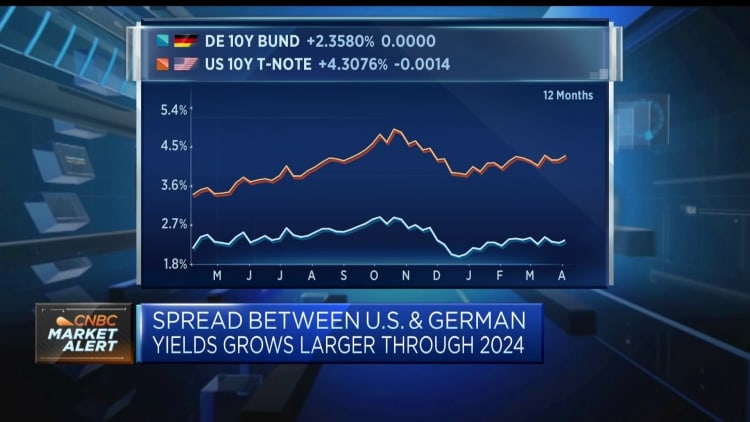
“That’s the kind of thing we should have been more conscious of doing. Instead of allowing [the] dollar to go wherever the market takes [it], and then these people who are not as fortunate as we are in the financial markets, end up suffering and end up voting for Mr. Trump,” Koo added.
He argued that economists need to move beyond the idea that the trade deficit is simply down to “too much investment” and “too few savings” in the U.S., as this means deficit can only be reduced by remaining in recession until domestic demand weakens so much that U.S. companies can export more goods, which would not be possible in a democracy.
Koo again pointed to past dealings with Japan, suggesting that if the argument held that overseas companies are just filling in where U.S. companies cannot satisfy domestic demand, then the American companies fighting Japanese firms in the 1970s and 70s should have recorded huge profits due to excess demand.
“But that did not actually happen. It’s the opposite that happened. So many of them went bankrupt, so many losers of free trade were left in the streets, because it was not savings and investment issue, it was the exchange rate issue,” he said.
“The dollar should have been much weaker, and Reagan understood that that’s why he took that action.”


