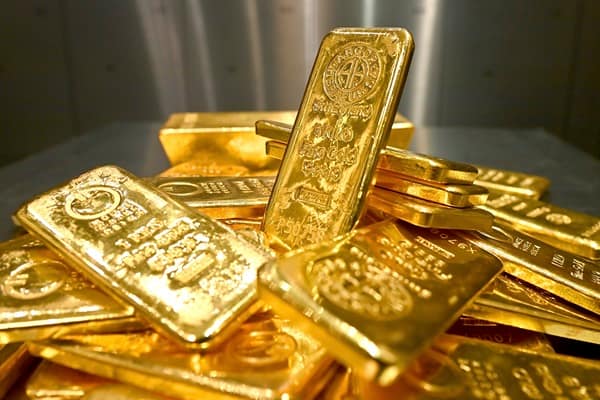
At a time when global markets are experiencing clear volatility, gold continues to move within an extremely sensitive range driven by a complex mix of fundamental pressures that have begun to confuse both traders and investors.
I therefore believe that the broader outlook for gold today is a direct result of the interaction of three main forces: the Federal Reserve’s tight monetary policy, the strength of the US dollar, and a turbulent economic environment marked by concerns over government shutdowns, weak data, and slowing growth.
As such, reading gold’s movements cannot rely on short-term price direction or temporary momentum, but rather on a deep understanding of the dynamics shaping risk appetite and redefining expectations for monetary policy.
Gold began the week supported by positive momentum stemming from some investors’ expectations that a monetary-easing cycle could begin in the near term—an assumption that would typically enhance demand for non-yielding assets.
However, that momentum quickly faded after cautious and hawkish statements from key Federal Reserve members, led by Kansas City Fed President Jeffrey Schmid, who made it clear that inflation remains far from target levels and that it is not yet time to discuss an imminent rate cut. From my perspective, these remarks were not merely reminders of conventional monetary policy but a direct message aimed at preventing markets from pricing in early easing, especially as inflation remains at levels the central bank finds uncomfortable.
With this shift in Fed rhetoric, the US dollar returned strongly to the forefront, benefiting from fading expectations of rate cuts and a widening gap between the US tightening cycle and other central banks’ policies. This rise in the dollar places direct pressure on gold by increasing its cost for foreign buyers and reducing its appeal as a safe haven. In my view, the dollar’s strength is not a temporary move tied to US data; it is a direct reflection of market conviction that the Federal Reserve is prepared to keep interest rates higher for longer than previously expected. This conviction automatically weakens any attempt by gold to reclaim a strong upward trend.
Meanwhile, the broader economic environment forms a complex backdrop that intensifies uncertainty. The recent US government shutdown disrupted the release of critical economic data, adding ambiguity to economic assessments and making investors more cautious. Adding to this, delayed and volatile data has begun to show early signs of weakening economic activity, opening the door to two opposing scenarios: either markets interpret this weakness as a reason to anticipate future monetary easing, or they view it as an additional risk that limits demand for highly sensitive assets, including gold. In my opinion, the combination of economic softness and political uncertainty may ultimately push the Fed toward a less hawkish tone—but only after the economy shows clearer signs of slowdown.
Despite the challenges, I see underlying economic pressure as still providing an important line of defense for gold at lower levels. When economic risks rise—whether due to government shutdown concerns, weakening data, or liquidity fluctuations—investors tend to reassess their positions and increase the defensive allocation in their portfolios, which renews interest in gold, even if only temporarily. From this perspective, I believe the price holding above the 4000 level is not just a technical line but a psychological balance point reflecting capital repositioning in anticipation of rapidly changing risks as further economic releases approach.
Recent price fluctuations clearly indicate that gold is moving within a broadening wedge pattern, a formation that reflects rising uncertainty and intensifying pressure from both buyers and sellers. We witnessed a failed attempt to climb above 4150, followed by a decline that drove the price back to retest the critical support zone. This behaviour, in my view, reflects a lack of genuine conviction among investors—neither toward continued buying nor aggressive selling. Markets are awaiting clear data, not speculation, to determine the next trend. And if gold manages to hold above the support area despite the strong dollar, it may indicate that buyers still believe economic risks justify retaining exposure to the metal.
However, the bullish scenario remains contingent on a shift in the Federal Reserve’s tone or the release of sufficiently weak data to convince markets that the tightening cycle has reached its end. If the upcoming FOMC minutes show a less hawkish stance, or if new data comes in below expectations, I expect gold to regain some of its upward momentum—particularly if it succeeds in breaking above the 4150 level again. Such a breakout could revive attempts to target higher levels near 4370, an area that may redefine the balance between buying and selling pressures.
On the other hand, a clear break below the 4000 level would put gold on a deeper corrective path and could push it back toward the base of the wedge or previous breakout zones. Yet even in this scenario, I do not expect the decline to be without limits, as rising global risks will continue to act as a natural barrier against excessive selling pressure. Accordingly, I believe that gold’s movement in the near term will remain governed by a delicate balance between monetary-policy pressures and economic uncertainty, with the final direction likely to be determined once the outlook for the Federal Reserve’s path becomes clearer in the months ahead.