No US military force is now expected over Greenland, but tariffs are rapidly emerging as President Donald Trump’s weapon of choice to pursue the territory, warns the CEO of global financial advisory giant deVere Group.
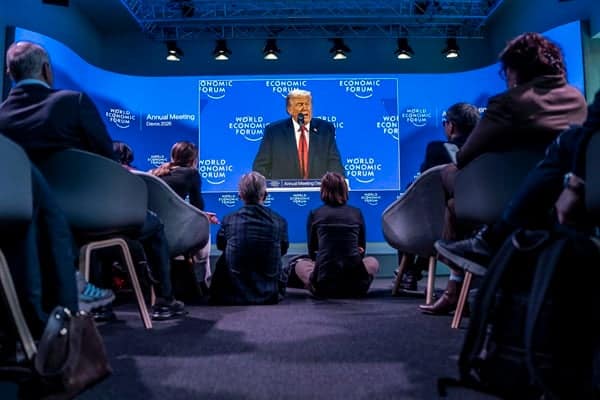
The stark warning from Nigel Green follows President Donald Trump’s address at the World Economic Forum in Davos, which sparked a relief rally across markets even as it seemed to reinforce a far more persistent economic risk.
Shortly after the opening bell on Wall Street, the S&P 500 and Dow Jones Industrial Average both rose around 0.3%, and the Nasdaq also made modest gains. Treasury yields fell as prices rose, while the dollar pared losses.
“Markets rallied because the immediate fear of military escalation seems to have eased,” says the deVere chief executive.
“But the speech in Davos was not conciliatory, it was highly aggressive. Trump repeatedly praised tariffs, defended their effectiveness, and presented them as a proven way to achieve national objectives.
“Investors should focus on what he consistently endorsed, not simply on what he ruled out.”
Throughout the speech, Trump highlighted tariffs’ roles in protecting US interests, securing leverage, and compelling outcomes, making clear that he views trade pressure as both legitimate and effective.
“He repeatedly hailed tariffs as a successful tool and doubled down on their power to deliver results. This could be seen as a warning shot to those countries he has already name-checked over the Greenland issue.”
Trump has already stated publicly that his pursuit of Greenland remains non-negotiable. With military force excluded, Nigel Green argues that the repeated emphasis on tariffs throughout the Davos address points to a clear strategic direction.
“When the president removes force from the equation and spends an entire speech championing tariffs, the implication is obvious,” he notes.
“Tariffs align with his worldview, his language, and his record.”
Markets, however, appear to be interpreting the absence of force as a broader de-escalation signal. The deVere CEO believes that reading is misplaced.
“Trade pressure is slower and less dramatic, but it could potentially be far more corrosive,” he says. “Tariffs feed into inflation, squeeze margins, disrupt supply chains, and weigh on growth. They reshape the investment environment over years.”
Europe remains particularly exposed. The European Union exports more than €500bn of goods to the US each year, leaving major sectors vulnerable even to targeted measures.
“Autos, industrials, luxury goods, and cross-border manufacturing networks, among others, would all be affected.”
Currency markets are also at risk of renewed volatility. Trade friction often supports the dollar in the short term while pressuring export-driven currencies and emerging markets, raising hedging costs and complicating capital allocation.
“Tariffs create rolling uncertainty in foreign exchange markets,” says Nigel Green. “This uncertainty does not disappear because equities bounce for a session or two.”
He stresses again that investors are underestimating the significance of the Davos message.
“Trump’s conviction was unmistakable,” he says. “He repeatedly underscored tariffs as a tool that works. Markets should assume that belief translates into action over Greenland.”
Green concludes that the current rally risks obscuring a deeper recalibration ahead.
“Removing military risk does not remove economic risk,” he says.
“It seems that tariffs remain the central lever in Trump’s strategy, and investors ignore that at their peril.”