Annual house price growth slowed in November, according to the latest Nationwide House Price Index. The mortgage lender reported that property prices rose by 1.8% year-on-year, down slightly from October’s pace, signalling a modest loss of momentum as the market heads into the end of the year.
On a monthly basis, prices increased by 0.3%.
* Seasonally adjusted figure (note that monthly % changes are revised when seasonal adjustment factors are re-estimated) Robert Gardner, Nationwide’s chief economist, said: “November saw a slight softening in the rate of annual house price growth to 1.8%, from 2.4% in October. However, prices increased by 0.3% month on month, after taking account of seasonal effects. “The housing market has remained fairly stable in recent months, with house prices rising at a modest pace and the number of mortgages approved for house purchase maintained at similar levels to those prevailing before the pandemic. “Against a backdrop of subdued consumer confidence and signs of weakening in the labour market, this performance indicates resilience, especially since mortgage rates are more than double the level they were before Covid struck and house prices are close to all-time highs.” The changes to property taxes announced in the Budget are unlikely to have a significant impact on the housing market. The high value council tax surcharge, which is not being introduced until April 2028, will apply to less than 1% of properties in England and around 3% in London. The chart below shows the share of property transactions by value band, which is a good proxy for the housing stock: 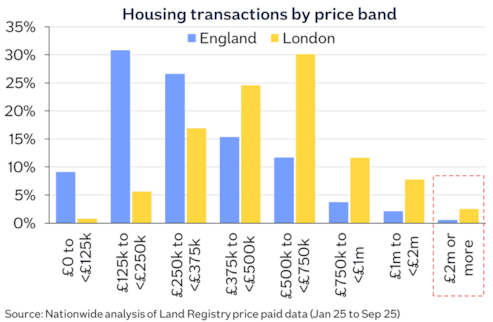 Gardner continued: “The increase in taxes on income from properties may dampen the supply of new rental properties coming onto the market. Rental supply has been constrained for some time, with the potential for this to maintain upward pressure on rental growth, which has been running at all-time highs in recent years. “Looking forward, housing affordability is likely to improve modestly if income growth continues to outpace house price growth as we expect. Borrowing costs are also likely to moderate a little further if Bank Rate is lowered again in the coming quarters. “This should support buyer demand, especially since household balance sheets are strong. Indeed, in aggregate, the ratio of household debt to disposable income is at its lowest for two decades.” |
Industry reaction:
Verona Frankish, CEO of Yopa: “A monthly increase in property values between October and November demonstrates just how robust the housing market has been, during a year that has been anything but settled when taking a wider view of the economic landscape.
“Buyers remain engaged, market activity is holding firm, and the market continues to move forward.
“Annual price growth remains consistently positive, which is the clearest indication of long-term market strength. Although the Budget offered little direct support, 2025 has proven that the market can perform strongly under its own momentum, leaving us well positioned as we move into 2026.”

Jeremy Leaf, north London estate agent: “Nationwide’s numbers paint the picture of a fairly stable market, despite lower confidence in the run-up to the Budget. However, as this survey reflects only customer activity and doesn’t include cash purchases, it may be timely but isn’t the most comprehensive of reports.
“With the property measures in the Budget not proving to be as harmful as some of the kite flying beforehand had indicated, expectations of a modest rebound are stirring a little more activity. With an earlier base rate cut more likely as the Bank of England gets a better hold on inflation, this may help encourage buyers and sellers to return to the market in January with more purpose.”
Amy Reynolds, head of sales at Antony Roberts: “While Nationwide reports little change in average house price data, on the ground the property market was sluggish in November, particularly at the higher end, as buyers and sellers sat tight ahead of the Autumn Budget. London property is directly tied to politics and the wider economy, and the drawn-out uncertainty over potential tax changes froze activity and would have cost the Treasury in lost stamp duty.
“Unfortunately, post-Budget nothing is cheaper, particularly stamp duty, so the pressure on the London market remains as before and will do so until there is intervention to stimulate the market.”
Guy Gittins, CEO of Foxtons: “The latest Nationwide figures show that, despite the uncertainty surrounding the Autumn Budget, the market has remained resilient.
“With Budget-related uncertainty now behind us and no changes to property taxes for the vast majority of the market, confidence is expected to rebuild as more households feel ready to resume their moving plans over the coming months.
“As we head into the New Year, the outlook is encouraging. Underlying demand remains strong, and this should help support activity as buyers and sellers re-engage.”
Marc von Grundherr, director of Benham and Reeves: “The fact that house prices posted positive monthly growth in November, even with intense Budget speculation hanging over the market, shows just how stable and resilient conditions have remained throughout 2025.
“This suggests the early formation of a late-season surge that often materialises as buyers and sellers push to put their plans to move in motion ahead of the New Year.”
Iain McKenzie, CEO of The Guild of Property Professionals: “Nationwide’s latest figures reflect a market that continues to demonstrate quiet resilience. While annual house price growth softened slightly to 1.8% in November, the fact that prices still rose 0.3% month on month underlines the underlying stability we’ve seen throughout the second half of the year.

“One of the factors keeping price growth modest is the rise in the number of homes coming to market compared with last year. Buyers now have more choice than they’ve had in years, which is helping to keep price pressures in check and encouraging more realistic, grounded negotiations on both sides.
“Importantly, this data captures a period when many potential movers were holding their breath ahead of the Autumn Budget. With so much speculation around possible housing reforms, some paused plans temporarily. Now that the Budget has passed, buyers and sellers will be able to move forward with more clarity.
“Despite the uncertainty, the market held up well, supported in large part by needs-based movers, who tend to drive activity outside the prime price bands. Their continued presence is reflected in the latest transaction numbers, with seasonally adjusted sales rising 2% between September and October to reach their highest level since March.
“Looking ahead, there is room for cautious optimism. Affordability should gradually improve as wage growth continues to outpace house price rises, and if inflation remains on its current trajectory, we may see the Bank of England begin reducing rates in the coming months, potentially as early as its next meeting. Any easing in borrowing costs would provide a welcome boost to both sentiment and activity as we head into the new year.
“Overall, the message from this latest data is clear: the market remains stable, active, and grounded, supported by solid fundamentals and a growing sense of confidence after a period of uncertainty.”
Shepherd Ncube, CEO of Springbok Properties: Despite a surprise monthly increase in the rate of house price growth, wider market conditions remain tough and the Autumn Budget has done nothing to help negate this fact.
“The market has been in a state of pre-Budget paralysis for many months and with the Government doing little to change this, we can expect the property market to limp to the finish line and start 2026 on the backfoot.
“Transaction timelines are likely to remain slow and frustratingly unreliable. For sellers who need to progress their plans in 2025 or early 2026, the risk is clear: delays will continue, and many will find themselves having to accept below-market offers if they want any chance of completing.”