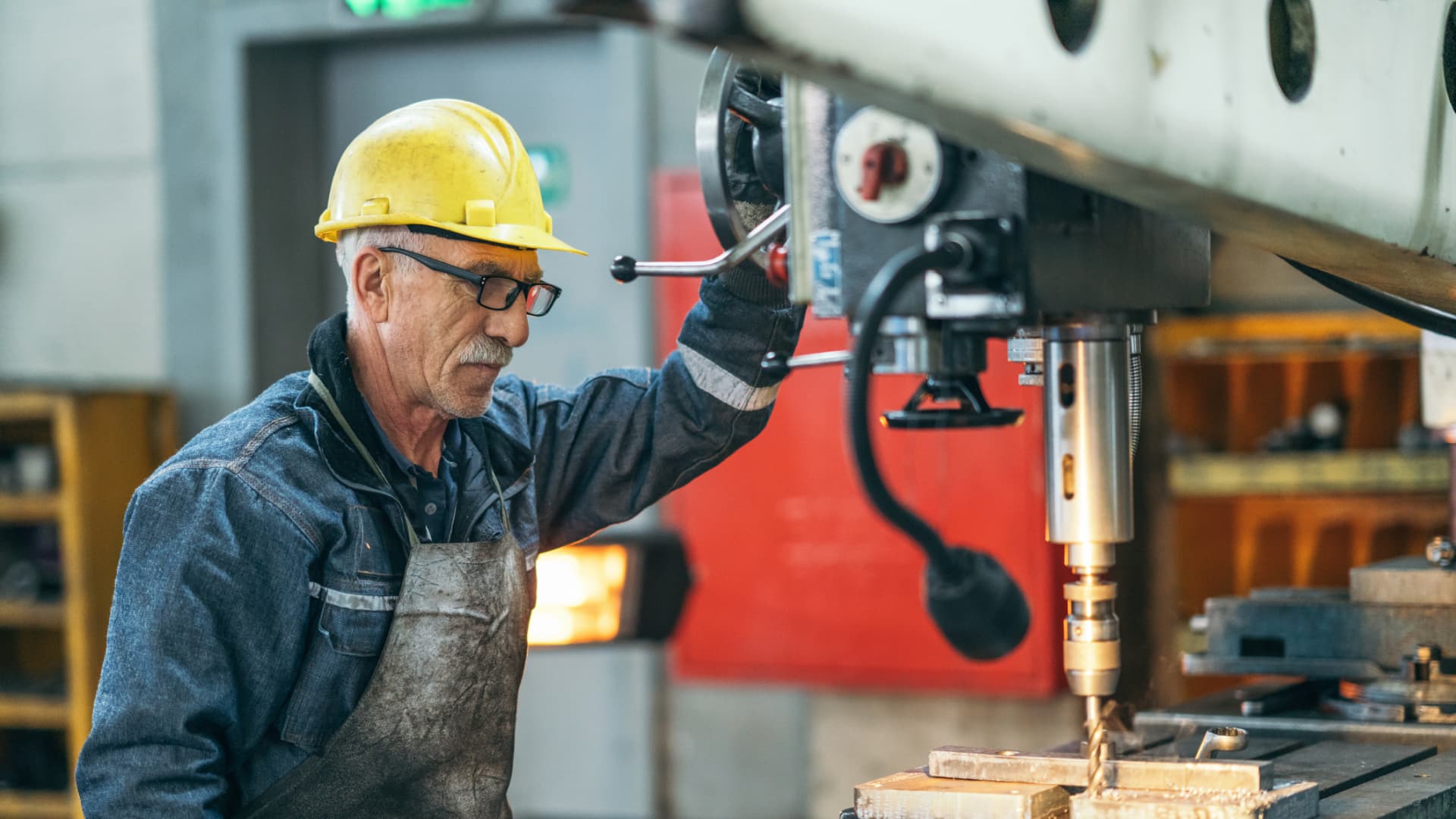
Turner worker working on drill bit in a workshop
Rainstar | E+ | Getty Images
The Social Security retirement age is currently moving to age 67, and some lawmakers have called for pushing it even higher.
But that may be a problem for a certain cohort: older workers in physically demanding jobs, according to a recent task force report from the National Academy of Social Insurance.
“It would be deeply irresponsible to further raise the retirement age before we’ve even gotten a handle on the damage that has been done to this group, and to other groups of workers, by the increase in the retirement age that’s already happening,” Rebecca Vallas, senior fellow at The Century Foundation and a task force member, said during a presentation this week on the report’s findings.
More from Personal Finance:
Will Social Security be there for me when I retire?
Medicare open enrollment may cut retirees’ health-care costs
How much your Social Security check may be in 2024
Social Security reforms passed in 1983 included gradual increases to the full retirement age, the point at which retirees may receive 100% of the benefits they earned. Today, people born in 1960 or later have a full retirement age of 67, which has been gradually phased in from age 65.
Workers in physically demanding jobs often claim early
When it comes to claiming Social Security retirement benefits, the advice is generally to delay as long as possible to get bigger benefits.
But workers who have physically demanding jobs may be unable to wait.
“There’s a lot of jobs that older workers are performing that you really can’t be expected to do well past the the early age of 62,” said Joel Eskovitz, director of Social Security and savings at the AARP Public Policy Institute and a task force member who worked on the report.
When those workers claim benefits early, they may find those reduced monthly checks fall short of the income they need. Moreover, those workers often do not have substantial retirement savings to fall back on due to low wages and a lack of access to retirement plans or pensions through their employers.
More than 10 million older workers face physical demands in their work, estimates the National Academy of Social Insurance‘s task force report. That includes those who work in warehouses, restaurants or as home health aides, for example.
“The task force universally agreed that this would only further harm this already economically vulnerable group of workers,” Vallas said of raising the retirement age.
Instead, the group suggested a host of policy changes that may help. That includes four Social Security benefit changes that may help this vulnerable population as they age, according to the task force.
1. Create a bridge benefit
A bridge Social Security benefit could help workers who cannot work until their full retirement age, but who are unable to claim Social Security disability benefits.
The bridge benefit would start from age 62, when claimants are first eligible for retirement benefits, and last until age 67, or full retirement age. Claimants would receive half the difference between what they would receive at full retirement age versus age 62.
For example, if someone is eligible for $1,000 per month in Social Security benefits at full retirement age, and a $700 reduced benefit at age 62, they may instead receive $850 at 62 with the bridge benefit, according to Eskovitz. The bridge benefit would be recalculated each year until full retirement age, when the worker would start receiving their full benefits.
To qualify, workers would need to have performed physically challenging work. Those who served in the most physically demanding positions would qualify at 62, while those qualifications would gradually become easier as ages increase.
2. Raise the minimum benefit
Tetra Images | Getty Images
Long-term low-wage workers who have not earned adequate retirement benefits may qualify for what is known as a special minimum benefit.
However, those benefits have risen slower than regular benefits because they are adjusted differently. Raising the minimum benefit would help, according to the task force.
Lawmakers have also been eyeing the change. One Congressional proposal, the Social Security 2100 Act, would bring lift an estimated 5 million people out of poverty by bringing up the minimum benefit, Rep. John Larson, D-Conn., said during a recent AARP event.
3. Create partial early retirement benefits
Some older workers may continue to work but reduce their hours as they age.
Allowing those workers to claim partial early retirement benefits may help make up for any lost income while also limiting the penalties for claiming before full retirement age. Research has found partial early retirement benefits, combined with the ability to turn the checks on and off, may improve retirement security for millions of Americans, according to the report.
4. Change the earnings test
People who claim Social Security retirement benefits before their full retirement age and who continue to work may be subject to an earnings test.
In 2024, that will apply to earnings above $22,320 per year, up from $21,240 per year in 2023. For every $2 above that limit, $1 in benefits will be withheld. (Higher limits apply for the year someone reaches their full retirement age.)
Importantly, the benefits that are withheld while a beneficiary is working are later added to monthly checks once they reach their full retirement age.
The earnings test may be a disincentive to work and is often misunderstood, according to the report.
By revising the earnings test, that may help bring the U.S. in line with other countries that have smaller annual retirement income reductions for working, according to the report.
Other policy reforms may help
The National Academy of Social Insurance report also highlighted other policy changes that may help workers in physically challenging jobs, including Social Security disability benefit reform, enhancements to services from the Social Security Administration, as well as improvements to other programs and administration.
Notably, that includes the idea of eliminating the reconsideration stage of the appeals process for Social Security disability benefits.
“This was something that actually got a lot of attention at a Ways and Means hearing last week, and actually a lot of bipartisan attention, which was pretty wonderful to hear,” Vallas said.
Other changes suggested in the report include providing employment and training programs for older workers, as well as strengthening unemployment insurance coverage available to them.