A new report produced by a coalition of environmental and social advocacy groups details forward progress being made across the industry towards more sustainable supply chains, with Tesla leading the pack and Chinese brands standing out as making the quickest progress in the last year.
There’s been a persistent myth among EV haters that despite electric cars having no tailpipe emissions, this is somehow offset by higher production emissions.
Nevermind that this isn’t true – the vast majority of a car’s emissions come from the use phase, namely from burning oil, and manufacturing emissions are a relatively tiny percentage of total emissions – but even those relatively low impacts from production are getting better, according to a new report.
The report is called Lead the Charge, and it’s produced by a coalition of advocacy groups surrounding the EV industry that you’ve probably read us report on before (Transport & Environment, Sierra Club, Public Citizen, etc.).
It covers two umbrella areas – “Fossil Free and Environmentally Sustainable Supply Chains” and “Human Rights and Responsible Sourcing.” Underneath these sections are many other aspects related to steel, aluminum, mineral and battery sourcing, and indigenous and workers’ rights. And it covers the top 18 automakers in the world as a sample of what the overall industry is doing.
The report is in its fourth year, which means it has been able to collect some data about automaker progress over time. And this year, it shows a marked improvement across the industry for the third year in a row – but there’s still work to be done.
Since the report started, automakers have nearly doubled their score on supply chain environmental and human rights impacts, and twice as many automakers now have taken steps to respect indigenous peoples’ rights as when the study started.
Notably, the report is not all EV-specific. There are subcategories for steel and aluminum production, materials that are commonly used in gas cars as well. These make up the largest chunk of weight in any given vehicle, so their impact has an outsized influence on the overall impact of automotive manufacturing.
And, some of these changes are driven by regulations. Europe has recently made pushes for more sustainable battery production and sustainable steel, both of which are reflected in the region’s higher rankings in those areas.
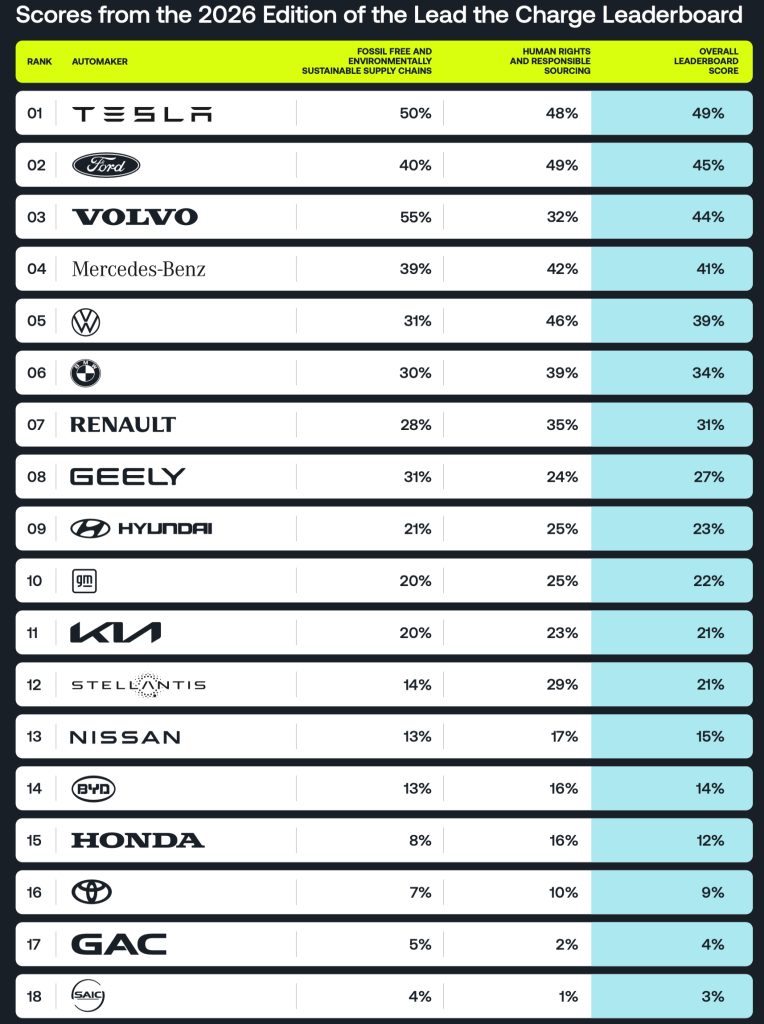
But the progress hasn’t been consistent across the industry. Top performers are making more progress than average or low performers, showing that the companies taking EVs most seriously are carrying most of the weight.
Top performers include Tesla, Ford, Volvo, Mercedes and Volkswagen, which the report highlights as standing out the most for their efforts. This stands to reason – these are some of the earlier movers on EVs, so we expect to see them ranked more highly, having had more time to make moves to clean up their supply chains.
But the report also points out that the two automakers with the most improvement this year were Chinese brands BYD and Geely, which led Chinese automakers to have the most improvement (compared to the overall US, EU, Korean, and Japanese industries). BYD still has lots of room to improve, but Geely is already a middle performer (and Volvo, owned by Geely, is third from the top, with the best environmental score).
Some Chinese brands still lag the field, though, which leaves the overall Chinese industry at the back of the pack, despite this improvement by the top performers. Japan is also at the bottom – it tends to beat China on the human rights angles, but lag behind it on the environmental angles.
Toyota, in particular, is in third-to-last place (trailed by SAIC and GAC, two Chinese state-owned automakers). The world’s largest automaker has also long been one of the world’s worst entities on climate issues, and seems to show little interest in changing. Honda and Nissan are both just ahead of Toyota.
Despite having laggards and leaders reflected in its ranks, the report measures a “best-in-class” score by looking at each automaker’s individual subcategory scores, theorizing a potential automaker which is a top performed in all categories.
For this year, that top score is an 86% – much higher than any individual automaker was able to achieve on its own. This shows that immense progress is possible simply by adopting best practices that are already in place across the industry, rather than theoretical moves which nobody has yet implemented.
You can check out the full report on the Lead the Charge website.
Charge your electric vehicle at home using rooftop solar panels. Find a reliable and competitively priced solar installer near you on EnergySage, for free. They have pre-vetted installers competing for your business, ensuring high-quality solutions and 20-30% savings. It’s free, with no sales calls until you choose an installer. Compare personalized solar quotes online and receive guidance from unbiased Energy Advisers. Get started here. – ad*


FTC: We use income earning auto affiliate links. More.