For the first time since the full-scale invasion of Ukraine began, a Russian politician has said the quiet part out loud, from a parliamentary podium.
The statement was brief, direct, and devastating: the so-called “Special Military Operation” has failed. Responsibility, he said, lies not only with the Kremlin, but with those who enabled it.
The response was immediate and entirely predictable. An administrative case for “discrediting the armed forces” was opened almost at once.
For the first time, a Russian politician called for an end to the war from the parliamentary podium.
As expected, Grigory Yeremeev, a politician from the Samara region, was issued an administrative protocol for “discrediting the army” after publicly making that call. pic.twitter.com/Tdl2VRwZQt
— Natalka (@NatalkaKyiv) January 31, 2026
In today’s Russia, punishment is not about justice; it is about containment. And the speed of the response tells us something important: the narrative is slipping.
These moments are not happening in isolation.
Bloomberg: Putin is running out of time
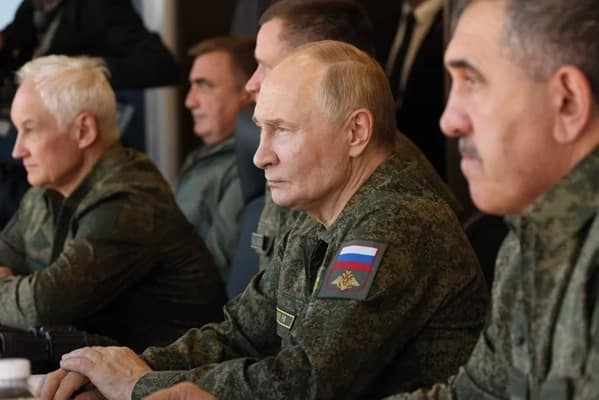
Within days, Bloomberg reported what many analysts and officials have been quietly acknowledging for months: Vladimir Putin is under mounting pressure, economically, militarily, and politically.
I have also previously reported that Russian propaganda is now operating in damage-limitation mode, no longer capable of selling victory, only explaining away failure.
The signs are increasingly obvious. State media and affiliated channels routinely inflate or fabricate battlefield successes, announcing the “capture” or “liberation” of settlements that Ukrainian forces still hold, or which lie kilometres behind the frontline. In several cases, cities such as Kupiansk and Pokrovsk have been declared taken multiple times over successive months, despite little or no meaningful change on the ground.
When advances fail to materialise, the narrative shifts abruptly. Tactical withdrawals are reframed as “regroupings”, stalled offensives become “operational pauses”, and heavy losses are downplayed or omitted altogether. I witnessed these distortions first-hand during my captivity. Maps shown on Russian television routinely contradicted independently verified satellite imagery, frontline reporting, and even accounts from Russian military bloggers operating on the ground. In my own case, broadcasts claimed full control of Makiivka and the surrounding area while Ukrainian artillery rounds were landing within the perimeter of the prison where we were held and had advanced to within 4km of the penal colony.
This reflects a system no longer attempting to convince its audience of success, but rather managing expectations and suppressing the visible consequences of failure. Propaganda has moved from mobilisation to mitigation, a clear indicator that the Kremlin understands it can no longer credibly claim momentum.
Russia is also facing a widening budget deficit, shrinking fiscal flexibility, and rising war costs that no longer match battlefield results. Oil revenues are under strain, mobilisation has become politically toxic, and the Kremlin is reportedly scrambling to cover shortfalls rather than plan long-term strategy.
Put simply: Time is no longer on Putin’s side.
This is not a familiar position for the Russian president. Throughout his entire tenure, from Chechnya to Georgia, Crimea to Syria. Putin has always been able to manufacture momentum, control escalation, or freeze conflicts on his terms having never faced this combination of military failure, economic constraint, and internal dissent simultaneously.
That is new, and it matters.
A War of attrition without progress
Wars of attrition only work if progress exists.
Russia has paid an extraordinary price, an estimated 1.2 million killed and wounded, yet, remains stalled, advancing at a pace better measured in metres than kilometres, while failing to achieve a single one of its original strategic objectives.
- Kyiv was not taken
- Ukraine did not collapse
- NATO did not fracture
- The Ukrainian state did not cease to exist
Instead, Russia is weaker globally, more isolated, increasingly dependent on repression at home, and clearly unable to protect even its own allies.
The military-bloggers turn inward
Perhaps more dangerous for the Kremlin than Western analysis is internal dissent from its own war ecosystem.
Russian military bloggers, once among the loudest cheerleaders of the invasion, have begun openly criticising leadership failures, strategic incoherence, and the absence of achievable goals. Social media platforms are increasingly flooded with images and accounts showing Russian soldiers killed, punished, or living in squalid conditions at the front.
Figures long embedded in the pro-war information space are now questioning:
- why territorial gains are so slow
- why losses are so high
- why promises made in 2022 remain unmet in 2026
Even voices such as Kolashnakov and Igor Girkin, among others in the mil-blogger sphere, have shifted from unconditional support to frustrated critique, not from a moral standpoint, but from a professional military one, and we all remember Yevgeny Prigozhin.
That distinction is critical, especially when remembering the former Wagner PMC founder.
These are not liberals or anti-war activists. They are insiders asking why a supposed great power is bleeding without direction. Historically, this is where authoritarian systems begin to turn brittle.
The Trump variable and why it matters
For years, the Kremlin has quietly banked on political division in the United States. That bet is now looking increasingly risky.
If Donald Trump is crushed in the US midterm elections, as current trends suggest, the consequences for Moscow could be severe. A weakened Trump removes the ambiguity Putin has relied upon, the hope that Western resolve might fracture or stall.
Instead, a post-midterm Washington could mean:
- firmer congressional backing for Ukraine
- tighter sanctions enforcement
- reduced tolerance for Kremlin delay tactics
For Putin, that closes doors rather than opens them.
A dangerous peace is worse than no peace
What we are witnessing is not collapse, yet, but something arguably more dangerous for the Kremlin: exposure.
Putin may now be forced to consider a peace deal not from strength, but from exhaustion. That is precisely where the danger lies. A settlement reached without firm security guarantees, enforcement mechanisms, justice for war crimes, and Ukrainian consent would not end the war, it would merely pause it.
History shows that Putin does not abandon objectives he fails to achieve; he postpones them. If the foundations are not set correctly, a rushed peace would almost certainly lead to a second attempt on Kyiv once Russia has regrouped, rearmed, and reconstituted its forces.
Make no mistake about the significance of what has just happened. When failure is spoken aloud in parliament, when bloggers turn critical, when budgets strain and time runs short, repression becomes the only remaining tool. And repression, by definition, signals fear.
Russia’s leadership still controls the state and the security services, but it no longer fully controls the story.
And in wars like this, losing the story is often the beginning of losing everything else.