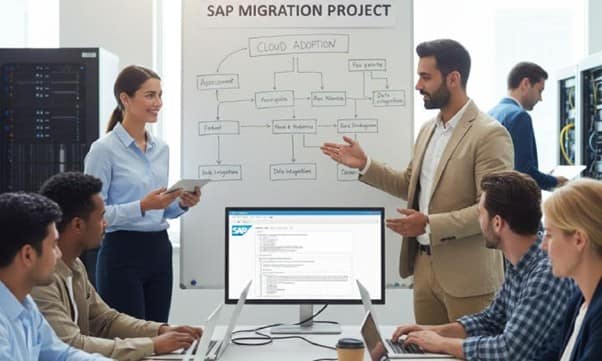
By 2026, SAP migration programs are no longer framed as discrete IT initiatives focused on system compatibility or platform upgrades. Enterprises increasingly approach migration as a strategic intervention tied to financial performance, operational resilience, and long-term scalability. Within this context, a well-defined SAP migration strategy has become central to how organisations translate platform change into measurable business outcomes rather than treating migration as a technical prerequisite for future transformation.
This evolution reflects a broader shift in executive expectations. Migration success is no longer evaluated by go-live stability alone, but by how effectively the new environment supports decision-making, cost discipline, and continuous optimisation across the enterprise.
The changing expectations of SAP migration programs
Earlier generations of SAP migration were driven by necessity. Hardware constraints, support deadlines, or system performance issues often dictated timelines, with success defined narrowly by functional parity and minimal disruption. While this approach reduced immediate risk, it frequently limited the strategic value of the migration effort.
In contrast, enterprises in 2026 approach migration with a more expansive lens. The underlying assumption is that a platform transition represents a rare opportunity to reset processes, data structures, and governance models that have accumulated complexity over years of incremental change. Migration is therefore positioned as a value intervention, not merely a compliance exercise.
This shift is reinforced by executive scrutiny. Boards and senior leadership increasingly demand clarity on return, risk exposure, and long-term operating cost implications before approving large-scale SAP programs.
From system conversion to business architecture realignment
One of the most significant changes in modern SAP migration programs is the move away from system-centric planning toward business architecture alignment. Rather than starting with technical pathways such as system conversion, landscape transformation, or selective carve-outs, leading organisations begin by assessing how core processes should operate in the future state.
This approach changes the sequence of decision-making. Process standardisation, data harmonisation, and organisational accountability are addressed early, shaping technical choices rather than being constrained by them. Migration becomes an enabler of business architecture simplification rather than a technical exercise constrained by legacy complexity.
As a result, enterprises achieve greater consistency across regions and business units, reducing operational variance and creating a more predictable execution environment.
Redefining risk in enterprise migration programs
Risk management has also evolved significantly. Traditional migration risk frameworks emphasised system downtime, data integrity, and cutover execution. While these factors remain critical, enterprises now recognise that the more substantial risks often emerge after go-live.
Post-migration risk frequently manifests as process inefficiencies, user workarounds, and unanticipated cost structures. These issues erode expected value and extend stabilisation periods. By 2026, leading organisations explicitly incorporate post-migration performance risk into their planning models.
This includes scenario analysis around adoption velocity, process compliance, and operational cost behaviour. Migration success is therefore measured not only by technical stability, but by the speed at which the organisation reaches a steady-state performance baseline.
Financial outcomes as the primary migration metric
A defining characteristic of modern SAP migration programs is the elevation of financial outcomes as primary success indicators. Enterprises increasingly link migration investments to metrics such as operating cost reduction, working capital efficiency, and productivity gains.
This financial orientation influences design choices throughout the program. Customisations that do not contribute to measurable value are challenged, and legacy processes that inhibit scalability are retired. Data structures are aligned to support real-time financial insight rather than retrospective reporting.
The result is a migration program that actively reshapes cost structures and decision-making capability, rather than simply transferring existing inefficiencies onto a new platform.
Organisational readiness and change absorption
Technical readiness alone is insufficient to realise enterprise value from SAP migration. By 2026, organizations acknowledge that the primary constraint on value realisation is often organisational, not technological.
Migration introduces new process ownership models, decision rights, and performance expectations. Enterprises that invest in structured change absorption programs experience faster stabilisation and higher adoption quality. These programs emphasise role clarity, process accountability, and ongoing performance measurement rather than one-time training events.
This approach reduces dependency on manual workarounds and reinforces standardised execution, allowing the organisation to operate closer to the designed future state.
Data as a strategic migration asset
Data considerations have moved from a supporting role to a central position in migration strategy. Rather than focusing solely on data transfer accuracy, enterprises now treat migration as an opportunity to rationalise data models and eliminate structural inconsistencies.
Master data harmonisation, data ownership definition, and lifecycle governance are addressed as part of the migration scope. This enables more reliable analytics, reduces reconciliation effort, and improves compliance outcomes post-migration.
Organisations that neglect these aspects often encounter persistent data-related issues that undermine confidence in the new environment, limiting the strategic impact of the migration.
Post-migration operating models and continuous value
Enterprises increasingly recognise that migration does not end at go-live. The operating model established after migration determines whether value is sustained or dissipates over time.
Leading organisations define post-migration governance structures that balance stability with controlled innovation. Release management, enhancement prioritisation, and performance monitoring are aligned to business objectives rather than technical milestones.
This operating discipline ensures that the SAP landscape continues to evolve in line with enterprise strategy, supporting continuous improvement rather than episodic transformation.
The role of advisory expertise in value-driven migration
As SAP migration programs become more closely tied to enterprise value, the importance of informed advisory support has increased. The complexity of aligning business architecture, financial objectives, and technical execution often exceeds the capacity of internal teams operating in isolation.
Enterprises increasingly engage a SAP expert partner with proven experience in value-oriented migration programs to provide architectural guidance, governance alignment, and objective risk assessment. Such partnerships contribute to disciplined decision-making throughout the migration lifecycle, helping organisations move beyond technical completion toward sustained business impact.
In 2026, the distinction between migration success and enterprise value realisation is defined not by the platform itself, but by the rigor with which transformation is conceived, executed, and governed over time.