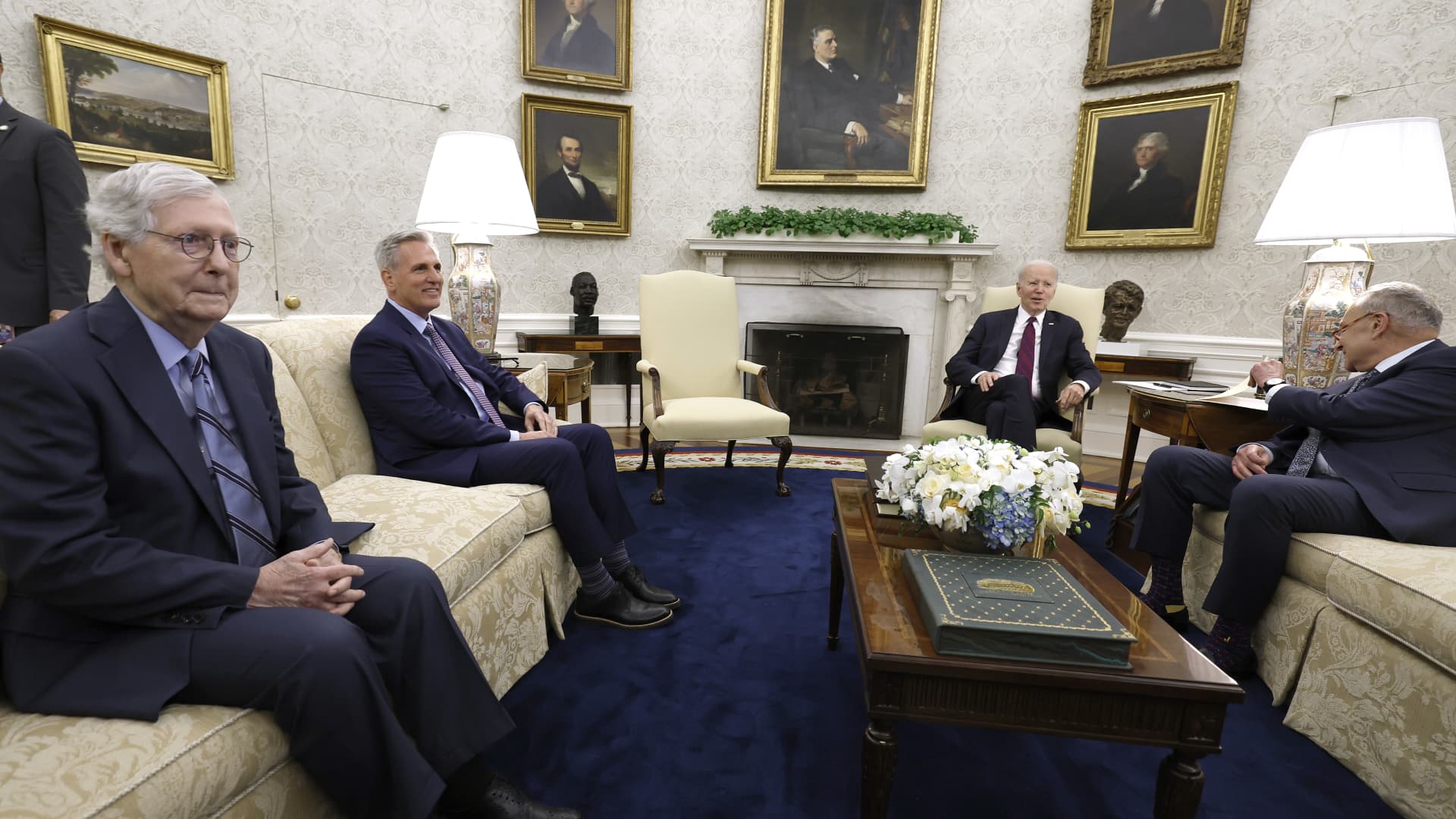
U.S. Senate Minority Leader Mitch McConnell, R-Ky.; Speaker of the House Kevin McCarthy, R-Calif.; President Joe Biden; and Senate Majority Leader Chuck Schumer, D-N.Y., meet in the Oval Office on May 9, 2023 to discuss the debt ceiling.
Anna Moneymaker | Getty Images News | Getty Images
The U.S. may be weeks away from being unable to pay its bills — an event that, should it come to pass, would likely be accompanied by broad and painful financial consequences for American households.
Among the ramifications of a debt ceiling standoff, any payment issued by the federal government — like Social Security, Medicare, tax refunds, military paychecks and ample others — may be delayed.
As an illustration, if the U.S. has just 80 or 90 cents for every dollar it owes, it will be forced to defer certain payments.
“Someone is getting shortchanged,” said Michael Pugliese, senior economist at Wells Fargo Economics.
More from Personal Finance:
How the debt ceiling may affect Social Security
Don’t change portfolio to beat the ‘looming recession boogeyman’
What the debt ceiling standoff means for money market funds
There are many unknowns: the length of any delay or if the government would prioritize certain payments, for example. The U.S. has never been in this situation and the government hasn’t issued a public road map outlining its response, meaning there’s a certain amount of guesswork involved.
“We’re looking at some sort of contagion effect,” said Rachel Snyderman, senior associate director of economic policy at the Bipartisan Policy Center, a think tank. “The degree of contagion is unknown.”
Why a standoff may delay federal payments
U.S. Treasury Secretary Janet Yellen on April 21, 2023 in Washington.
Alex Wong | Getty Images News | Getty Images
The U.S. is in this situation due to a political standoff tied to the debt ceiling, also known as the debt limit. This ceiling is the amount of money the U.S. is authorized to borrow to pay its bills.
The nation runs a budget deficit, meaning it spends more than it makes in revenue. It must therefore borrow money to meet its obligations.
Congress periodically raises or temporarily suspends the debt ceiling to avoid the other scenario: a default on the national debt and other federal payments.
Here’s the current problem: The country hit the debt ceiling — currently $31.4 trillion — in January. Since then, the U.S. Department of the Treasury has been able to shift money around and delay the so-called “X-date,” the day on which the federal government can no longer pay its bills in full.
That date may be as soon as June 1, Treasury Secretary Janet Yellen said last week.
But a political impasse between Democrats and Republicans means a deal has, so far, been elusive.
If the U.S. reaches the X-date without a debt ceiling deal, it would be the first time in U.S. history that the federal government has intentionally reneged on its financial promises.
This is where the hypotheticals around “who gets paid and when” start to come into play. Some clues and educated guesswork can help to answer that question.
Bondholders prioritized to avoid ‘financial Armageddon’
It’s likely that the government would first pay investors and financial entities holding U.S. Treasury bonds. These payments to bondholders would be for principal and interest.
Federal Reserve officials alluded to the likelihood of prioritizing bondholders in a 2011 meeting that followed an earlier debt ceiling episode.
Not doing so would trigger a “technical default.” In other words, the U.S. would default on its debt payments.
While missing any federal payment would likely sow chaos, the scenario of missed bond payments “is what would really trigger financial Armageddon,” Wells Fargo’s Pugliese said.
U.S. Treasury bonds are the foundation of the whole global capital structure, he said.
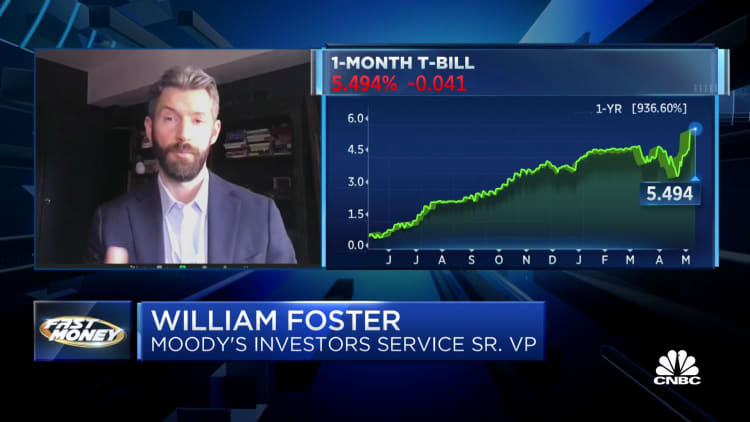
The market for Treasury bonds — worth about $24 trillion — is the “largest and deepest bond market in the world,” according to a Wells Fargo research note.
They’re held by all sorts of global investors, like U.S. and foreign banks, insurers, retirement funds, mutual and exchange-traded funds, sovereign wealth funds and individuals.
Investors view them as a risk-free asset. Holding short-term Treasurys is theoretically “the one super safe thing you can do” with your money, Pugliese said.
“What does the world look like when nowhere is safe?” the economist said, posing a theoretical question.
In short: Investors might panic, dumping Treasury bonds and triggering a deep sell-off in stocks.
Ratings agencies would likely downgrade U.S. debt. Government borrowing costs would increase, as would those for households which have credit cards, mortgages, auto loans and other debt, which is linked to the U.S. Treasury market.
‘The big question mark’ of who comes second
Bill Clark | Cq-roll Call, Inc. | Getty Images
Putting boldholders first inevitably puts others second.
Prioritizing who comes next is the “big question mark” in the grand scheme of unknowns, said Snyderman of the Bipartisan Policy Center.
All federal payments are on the table. Delays might initially last a day or two, but would grow along with the duration of a political impasse, she said.
The most consequential would likely be Social Security benefits and money for health programs like Medicare, Medicaid, the Children’s Health Insurance Program and Affordable Care Act health plans, experts said.
For example, the government is scheduled to pay roughly $100 billion each to Medicare and Social Security in June — dwarfing other federal payment categories, according to a recent Bipartisan Policy Center analysis.
We’re looking at some sort of contagion effect. The degree of contagion is unknown.
Rachel Snyderman
senior associate director of economic policy at the Bipartisan Policy Center
Deferring payments to federal health programs might mean, for example, that some health-care providers delay care for enrollees. Retirees, who may live on fixed incomes, may have trouble paying their bills, experts said.
Other payments might be affected too: federal tax refunds; the Supplemental Nutrition Assistance Program (also known as food stamps); payments to federal retirement plans like the Thrift Savings Plan; education programs like Pell Grants; federal salaries like those of judges and active-duty military members; veterans benefits; and payments to defense vendors and contractors, for example.
It’s unclear if the government would prioritize certain payments within these broad groups. The most likely scenario is funds would be issued chronologically according to when certain payments fall in the calendar cycle, experts said.
“It’s completely operationally, economically and legally untested,” Snyderman said. “We would be in uncharted territory.”