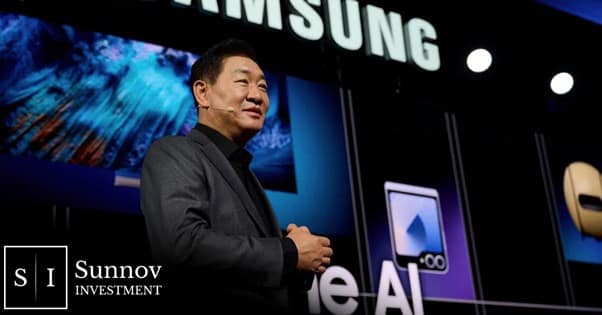
Analysts highlight how Samsung’s multi hundred-billion-dollar artificial intelligence investment programme, new high bandwidth memory capacity in Pyeongtaek and additional AI data centres across South Korea reshape the global semiconductor landscape.
Global investors are focusing on Samsung Electronics as the group sets out a five-year artificial intelligence investment programme worth $310 billion over the coming five-year period, with analysis from Sunnov Investment Pte. Ltd. highlighting how the plan reshapes expectations for capital spending across the semiconductor industry.
The commitment concentrates on AI specific semiconductors and on domestic manufacturing capacity in South Korea. Samsung is expanding its memory operations through a new facility at Pyeongtaek, known as Plant 5, which is designed for the production of high bandwidth memory chips that feed the specialised computing clusters on which generative AI systems depend. By situating this plant within its existing campus, the company seeks to streamline supply chains and secure production volumes over the course of the next decade.
The broader programme also spans battery technology and display manufacturing. Samsung’s battery business assesses the case for next generation all solid-state systems from domestic lines, whilst the display division prepares an advanced organic light emitting diode factory in South Chungcheong that is scheduled to move into full scale production during the next annual cycle. In combination, these initiatives deepen South Korea’s high value technology ecosystem at a time when global competition for AI infrastructure intensifies.
Samsung SDS, the group’s IT and logistics subsidiary, is extending the infrastructure required to use these chips. Plans for new artificial intelligence data centres in South Jeolla Province and in Gumi add to an existing network of facilities in Sangam, Suwon, Chuncheon, Dongtan and Gumi that are in operation at the time of publication. The Gumi project follows the transfer of an established electronics plant and is configured to provide higher computing speeds and lower power consumption for corporate and public sector clients.
In parallel, proposals for a National AI Computing Centre bring government resources directly into the picture. Samsung SDS is submitting bids for an initiative valued at $1.8 billion over its planned construction period that targets 50,000 high performance graphics processing units by 2030, with the complex expected to sit within the Solarseado Data Centre Park in Haenam. Policy makers are steering a larger share of public spending towards artificial intelligence programmes over forthcoming fiscal years, including workforce training and regulatory modernisation, in order to position South Korea just behind the United States and China in this field.
Market data reviewed by the Singapore based investment manager indicates that this policy environment meets a favourable commercial backdrop. Contract prices for 32 gigabyte DDR5 memory modules, for example, rise from around $142.2 at the start of the two month period from September to November to approximately $228.1 at the end of that same interval, a 60% increase over those two months. High bandwidth memory volumes remain constrained relative to demand across that period, and customers deploying advanced AI models continue to compete for allocations.
For investors seeking to interpret these moves, the question is how far Samsung’s capital programme changes the balance of power within global semiconductors. In the view of Thomas Gardner, Director of Private Equity at Sunnov Investment Pte. Ltd., “this scale of long-term AI investment effectively resets the bar for what leadership in memory and infrastructure requires over the next five years, especially when a single group brings manufacturing, data centres and cloud partnerships into one plan”.
Gardner points to the interaction between corporate spending and public policy, arguing that “when a government sketches out a route to AI leadership and a national champion aligns its own capital plans with that timetable over several budget cycles, investors gain a clearer sense of potential support for earnings, research spending and strategic acquisitions”.
In practical terms for clients, Gardner notes that “although supply expands, certain types of high bandwidth memory and AI computing capacity still look scarce through planning horizons of two to three years, so pricing power currently remains with those manufacturers that can qualify new products quickly and secure energy efficient data centre space”.
For the investment manager, the immediate focus lies in how these developments filter through company balance sheets, trade flows and equity valuations. The interplay of Samsung’s five-year AI programme, the build out of Pyeongtaek Plant 5 and the proposed National AI Computing Centre offers a real time case study in how capital markets, technology strategy and industrial policy intersect. Investors who monitor these signals closely, according to Gardner, are better placed to assess which parts of the global semiconductor and cloud ecosystem stand to benefit most from the current wave of expenditure.
About Sunnov Investment
Sunnov Investment is a Singapore based investment manager, established in 2012, that serves accredited investors, foundations and endowments worldwide. The firm manages long only equity strategies alongside complementary long and short equity, global macro, event driven and systematic mandates, and it develops structured routes for eligible retail participation.
Website: https://sunnov.com · Media enquiries: Deng Hui, [email protected] · Registered entity: Sunnov Investment Pte. Ltd. · UEN: 201225494E