Tesla has opened its first Megacharger station to Semi customers at a new location in Ontario, California, marking a significant milestone in its push to build a charging network for electric trucks.
The opening comes as Tesla ramps up Semi production at its dedicated Nevada factory and accelerates its plan to deploy 66 Megacharger locations across the US.
Ontario Megacharger location
The Tesla Semi team announced the opening on X (formerly Twitter), confirming that the Megacharger station at 4265 E Guasti Road in Ontario, California, is now live and available to Semi fleet customers.
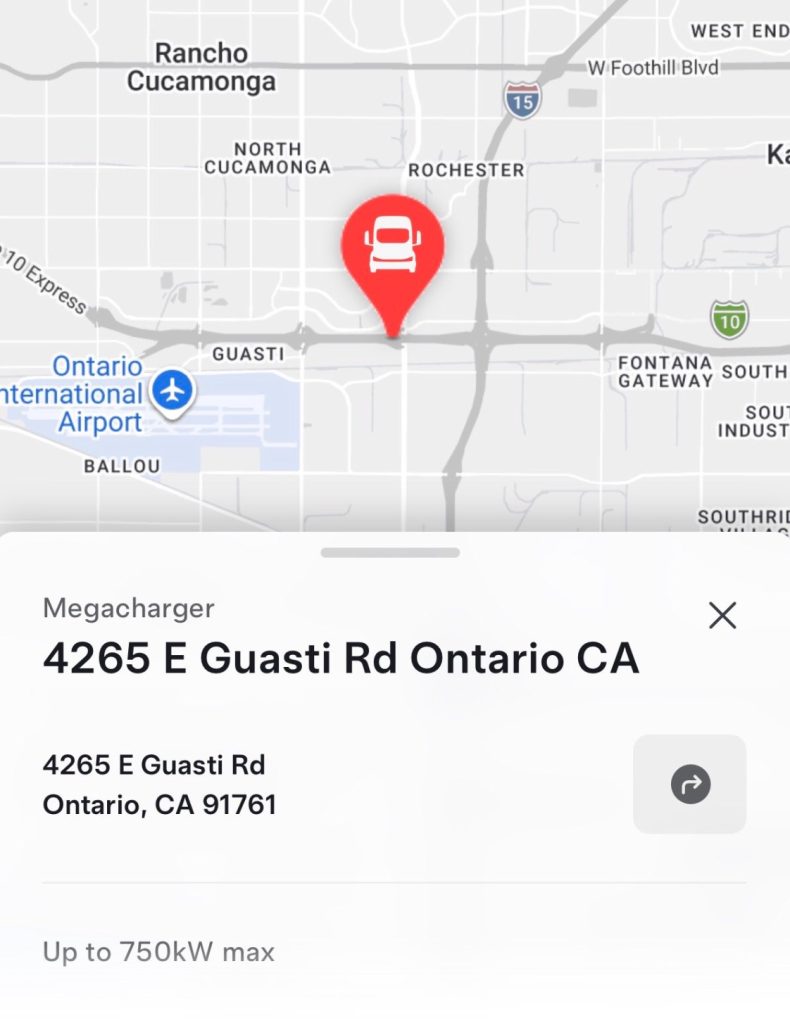
The location was strategically chosen. Ontario sits in the Inland Empire, one of the busiest freight corridors in the world, near the interchange of the I-10 and I-15 freeways. That position makes it a critical link for electric trucks moving goods between the Ports of Los Angeles and Long Beach and major distribution centers further inland.
Tesla’s Megachargers can deliver up to 1.2 MW of charging power, enough to replenish up to 60% of the Semi’s range in roughly 30 minutes. That’s the kind of speed that makes electric long-haul trucking viable during mandatory driver rest breaks.
Interestingly, Tesla mentions that this first public Megacharger is limited to 750 kW.
Tesla already has two other Megacharger sites operational — one at Giga Nevada in Sparks and a dedicated facility in Carson, California, near the 405 and 110 freeways and the Port of Long Beach, with up to 12 stalls. But those have primarily served Tesla’s own fleet operations. The Ontario location appears to be the first station explicitly opened for customer use.
Megacharger network expansion
The opening is part of a broader infrastructure push that has accelerated significantly in recent months. In February, Tesla added 64 new Megacharger locations to its map, bringing the total to 66 planned sites across 15 states. Texas leads with 19 planned sites, followed by California with 17. The network targets the busiest freight corridors in North America: I-5 on the West Coast, I-10 as an east-west artery, and I-95 and I-75 along the East Coast.
Tesla Semi program lead Dan Priestley has said the company aims to deploy 46 Megacharger stations by early 2027, with approximately 37 sites planned for 2026.
Adding to that momentum, Tesla landed a deal with Pilot, the nation’s largest truck stop operator and a Berkshire Hathaway subsidiary, to install Megacharger stalls at select Pilot travel centers along I-5, I-10, and other major corridors. The first Pilot sites are expected to open by summer 2026, with each location hosting 4 to 8 Megacharger stalls.
Competitive context
Tesla is moving fast, but it’s not the only player. The Megawatt Charging System (MCS), an open industry standard that supports up to 3.75 MW, is gaining traction in Europe and the US. Truckmakers Daimler, Volvo, and Scania (part of the Traton Group) are all preparing MCS-compatible electric trucks for commercial deployment in 2026. Kempower is deploying MCS infrastructure at what it calls the largest grid-connected MCS site in the US, at a truck fleet hub in San Bernardino — not far from Tesla’s new Ontario station.
The difference is that Tesla already has trucks on the road and chargers plugged in. Competitors are still largely in the announcement phase for megawatt-class charging. That first-mover advantage matters in an industry where fleet operators need to see working infrastructure before committing to electric.
Electrek’s Take
This is a meaningful step. Opening a Megacharger to customers, not just Tesla’s own operations or limited partners, signals that the Semi program is transitioning from pilot phase to commercial reality.
We’ve been tracking Tesla’s Megacharger buildout closely, and the pace has picked up significantly since late 2025. The 1.2 MW charging demonstration in December, the 64-location map update in February, the Pilot deal in January, and now an actual customer-facing station in March — that’s a lot of momentum in a short period.
The Ontario location makes sense. The Inland Empire is the beating heart of goods movement in Southern California, and any fleet electrifying its drayage or regional haul routes needs charging right there. Combined with the Carson station near the ports, Tesla is starting to build a real corridor in the LA basin.
The bigger question is whether Tesla can maintain this pace. Going from 3 operational sites to the 37 planned for 2026 is a massive ramp. The Pilot partnership should help, but permitting, utility interconnection, and construction timelines are the real bottlenecks for any charging network. We’ll be watching closely to see how many of those 66 planned locations actually come online this year.
If Tesla can do for electric trucks what it did for passenger cars with the Supercharger, it is going to be a big deal.


FTC: We use income earning auto affiliate links. More.