Free speech is one of the West’s greatest strengths. It allows criticism of government, exposure of wrongdoing, and public debate, even in wartime. It is the foundation of democratic accountability.
But free speech was never designed to be unilaterally exploited by hostile states engaged in active war, as Russia is today.
The legal and moral dilemma facing Western democracies is not whether criticism should be protected, it must be, but whether participation in a foreign state’s information warfare can continue to hide behind the language of free expression.
Because that is precisely how modern propaganda operates.
The legal boundary: Speech vs conduct
Under UK and European law, speech itself is rarely criminalised.
However, conduct associated with speech absolutely can be.
Key legal principles already exist:
- Material support to a hostile or sanctioned state
- Assistance to enemy propaganda or psychological operations
- Collaboration with sanctioned entities
- Participation in war crimes, or their facilitation
The UK’s Sanctions and Anti-Money Laundering Act 2018, alongside Russia-specific regulations, makes it an offence to provide services — including media and publicity services — that benefit sanctioned entities or further their objectives.
Read more related news:
Elite Ukrainian special forces take out a Russian ship in the Mediterranean
Crucially, journalism is not automatically exempt if it crosses into active collaboration.
This is not theoretical.
It has already been tested.
Graham Phillips: A legal precedent, not an anomaly
Graham Phillips, a British national, was sanctioned by the UK government in 2022.
The justification was explicit: he was found to be involved in Russian information operations that undermined Ukraine’s sovereignty, including content linked to the exploitation and abuse of prisoners of war.
Sanctions imposed included:
- Asset freezes
- Travel restrictions
- Prohibition on providing services that benefit him
Phillips has since not returned to the UK and operates from Russia and occupied Ukrainian territory, a telling fact in itself. His continued absence strongly suggests an understanding that return would likely expose him to arrest, investigation, or prosecution, not for opinion, but for conduct.
This matters because it establishes a clear legal threshold: When speech becomes operational, it ceases to be protected expression.
Phillips is not a so-called “journalist” being silenced. He is a case study in how information-warfare actors exploit Western tolerance until the law catches up.
Exclusive: Brit Graham Phillips exposed as Putin’s thug wanted for war crimes
How propagandists weaponise free speech
Modern propaganda does not look like Cold War posters. It looks like podcasts, panel discussions, “academic” essays, and Western accents on state television.
The tactics are well documented in Russian military doctrine and reflected in NATO STRATCOM analysis:
- Narrative laundering: Kremlin talking points delivered by non-Russian voices to increase credibility — including interviews conducted by RT with Western participants, myself included.
- False balance: Aggression reframed as “complexity” or “mutual fault.”
- Denial without denial: War crimes are not defended — they are “questioned,” “contextualised,” or drowned in doubt.
- Asymmetric openness: Western platforms are used freely while those same platforms are banned or restricted in Russia.
This is not accidental. It is strategic.
According to EU monitoring bodies, over 80% of identified Russian disinformation campaigns targeting Europe rely on non-state or Western-based intermediaries, rather than official Kremlin accounts. The objective is simple: plausible deniability.
The X (Twitter) asymmetry
The contradiction is stark.
X is effectively blocked or restricted in Russia, with access largely dependent on VPN use. Independent journalists, opposition figures, and anti-war activists face arrest for posting content far less incendiary than what Russian officials post daily on Western platforms.
Yet figures such as:
- Dmitry Medvedev
- Kirill Dmitriev
- Other Kremlin-aligned commentators
Openly threaten nuclear annihilation, mock civilian suffering, and escalate rhetoric designed to induce fear all while travelling freely to Western states, attending meetings, and enjoying protections their own citizens are denied.
This is not free exchange.
It is one-sided exposure, anything but free speech.
Western platforms amplify content that would be illegal, censored, or criminal inside Russia, while Russian citizens cannot respond in kind and remain deeply restricted.
Legal statistics: Enforcement lag, not legal absence
The problem is not lack of law. It is lack of enforcement.
- Since 2014, over 2,000 individuals and entities have been sanctioned by the UK, EU, and US in relation to Russia.
- Fewer than a handful of cases involve media or information operatives.
- Despite extensive evidence of coordinated propaganda activity, prosecutions remain extremely rare — largely due to political hesitation rather than legal barriers.
In contrast, counter-terror legislation has been applied aggressively where media activity intersected with ISIS or Al-Qaeda propaganda, including cases involving online dissemination alone. Individuals have been prosecuted not for committing violence, but for producing, sharing, or amplifying material deemed to advance the operational aims of a hostile actor.
The disparity raises an uncomfortable question: Why is state-backed information warfare treated more leniently than non-state extremism?
This inconsistency is stark when applied to Russian state media.
RT, a broadcaster wholly owned and funded by the Kremlin, has been banned or restricted across much of Europe because it was assessed not as independent journalism, but as an instrument of Russian state information operations during an active invasion.
Yet the same outlet, or its personalities, narratives, and content, continues to circulate freely on Western social-media platforms such as X, and in the United States through redistribution on platforms like Rumble. In effect, content deemed too dangerous to broadcast in Europe is simply laundered through digital platforms elsewhere.
The recent Tenet Media scandal exposed just how porous the Western information space has become. What appeared to be an independent alternative outlet was shaped by undisclosed funding, opaque influence networks, and narratives consistently aligned with Kremlin strategic interests. While not every contributor was knowingly complicit, the case demonstrated how foreign state messaging can enter mainstream debate without overt state branding, a warning sign of how modern information warfare now operates in plain sight.
The justification is often that RT is a state broadcaster rather than a terrorist organisation, and its output is therefore treated as political speech. But terrorism law does not hinge on whether an actor is state or non-state; it hinges on intent, effect, and harm. I experienced that harm directly.
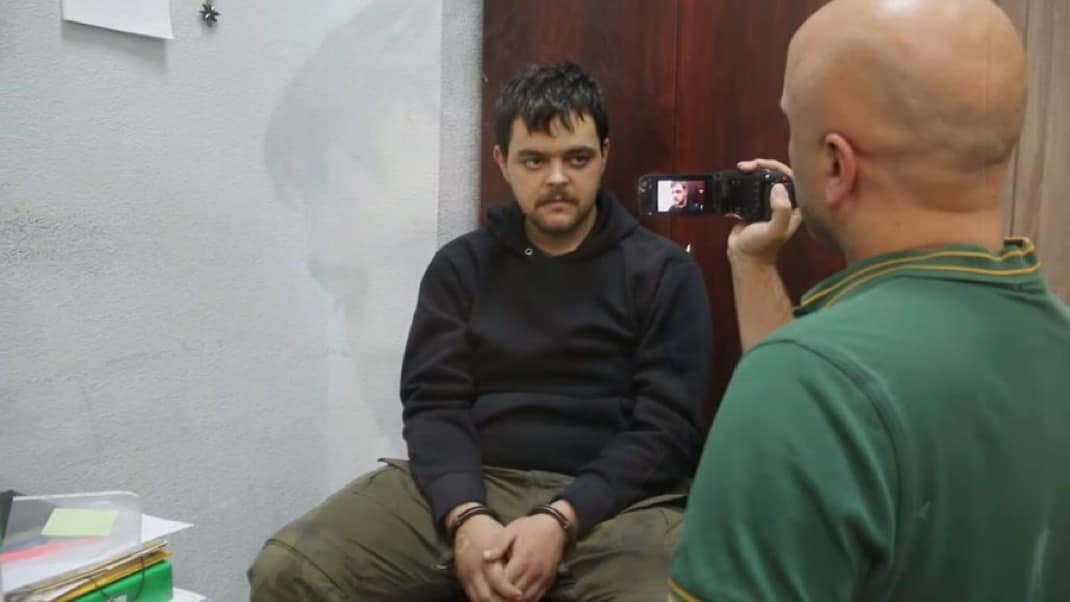
Long before my sham trial, I was subjected to a trial by public opinion conducted through Russian state media, with RT playing a central role in framing me as guilty while I was still in captivity. RT programming was used to legitimise my detention, dehumanise me publicly, and prepare the ground for a predetermined outcome. One presenter in particular, Roman Kosarev, was directly involved in broadcasts linked to my captivity and interrogation environment while I was undergoing metal torture. He continues to appear openly on Western platforms such as X for RT still as a presenter, despite having worked alongside those responsible for my abuse.
That is not abstract political speech. It is media participation embedded in coercion, abuse, and psychological warfare — and it illustrates precisely why intent, effect, and harm matter more than labels.
ISIS propaganda was criminalised not because it lacked a flag, but because it used media to intimidate civilian populations, legitimise violence, and support ongoing hostilities. Russian state media performs an analogous function, the only difference being its official status. This distinction is further obscured by language.
Moscow insists on describing its invasion of Ukraine as a “Special Military Operation” rather than a war, a deliberate attempt to shape legal thresholds, dilute responsibility, and normalise aggression. When that terminology is repeated uncritically in Western discourse, it is not neutral description but adoption of the aggressor’s framing.
Wording matters because it determines whether something is treated as war propaganda or merely opinion, even as the same state openly issues nuclear threats and conducts large-scale military operations.
The result is a two-tier approach to propaganda enforcement: zero tolerance when media activity supports non-state extremism, and permissive ambiguity when the same techniques are deployed by a state actor.
That gap is not accidental. It reflects political caution, platform incentives, and outdated assumptions about state media, and it leaves democratic systems uniquely exposed to information warfare conducted under the cover of free speech.
Journalism or participation?
This is the line that must be drawn.
Journalism:
- Challenges power
- Accepts evidence
- Operates independently
- Is open to correction
Propaganda participation:
- Aligns consistently with a hostile state’s objectives
- Operates within that state’s media ecosystem
- Ignores or denies documented crimes
- Amplifies fear, division, or defeatism
- Shows no independence from the host platform
Intent matters, but effect matters more.
International humanitarian law already recognises that civilians can lose protected status if they directly participate in hostilities. Information warfare is now explicitly recognised by NATO and EU defence frameworks as a domain of conflict.
The law has not caught up in application, but the principle is established.
How do we deal with it?
Not through censorship.
Through:
- Enforcement of existing sanctions law
- Transparency requirements for foreign state media participation
- Platform-level designation of state-aligned contributors
- Visa and travel restrictions tied to propaganda activity
- Clear legal guidance distinguishing journalism from collaboration
This is not about silencing dissent.
It is about defending democratic systems from being used as weapons against themselves.
Conclusion: Free speech is not a suicide pact
Free speech is a shield, not a loophole.
When individuals knowingly embed themselves within hostile state media, amplify its war narratives, and assist its strategic messaging, they are no longer neutral observers.
They are participants.
The case of Graham Phillips proves the line exists. The failure is that it is rarely enforced.
Wars today are fought not just with artillery and drones, but with narratives, platforms, and credibility. If democracies cannot defend the informational domain, legally, proportionately, and confidently, they will continue to fight with one hand tied behind their back.