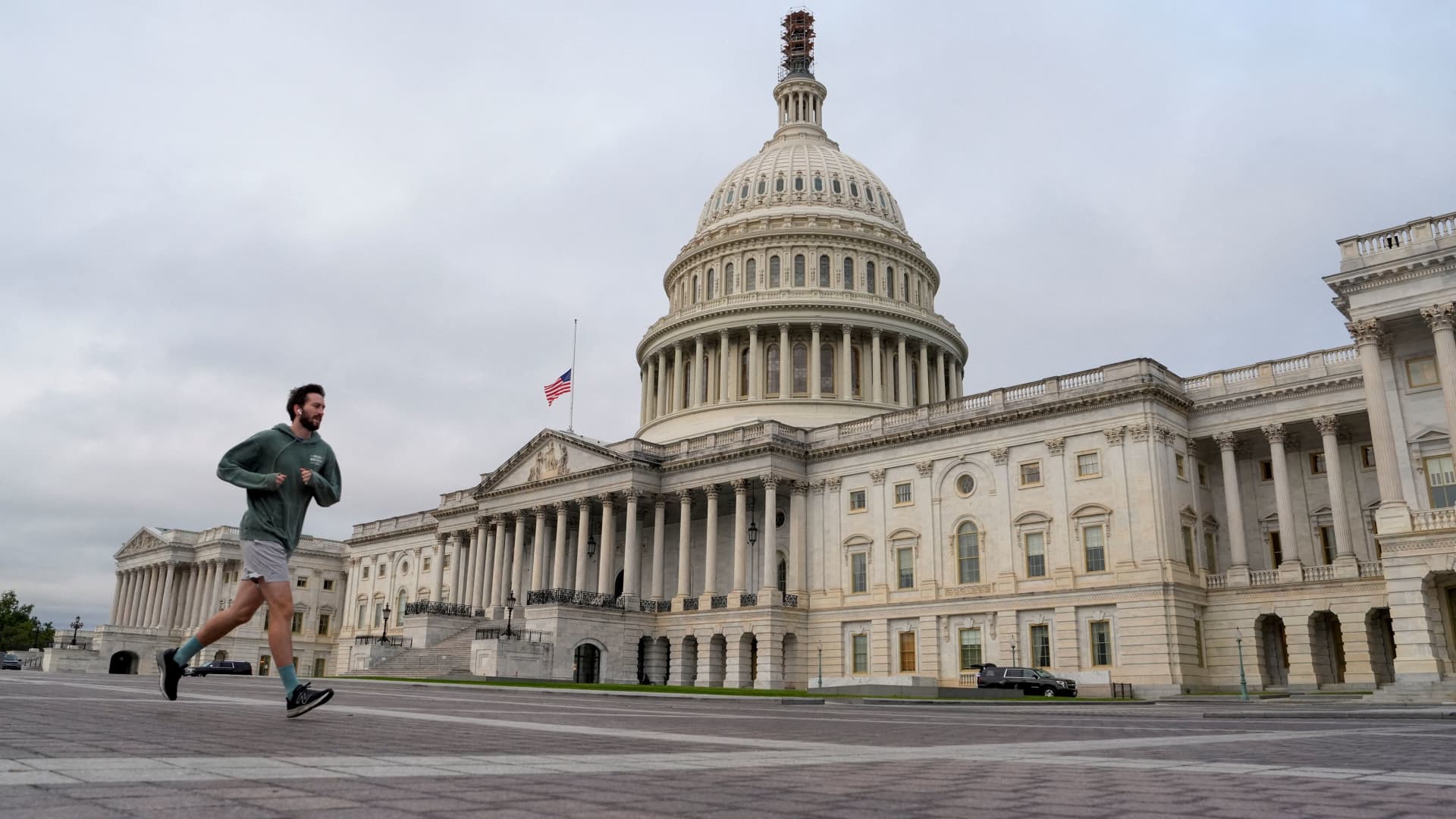
A jogger runs by the U.S. Capitol as the deadline to avert a partial government shutdown approaches at the end of the day on Capitol Hill in Washington, U.S., September 30, 2023.
Ken Cedeno | Reuters
BEIJING — The U.S. Congress increasingly has its eye on American capital that’s allegedly funded China’s military development, indicating that greater scrutiny on U.S. investments into China may outlast presidential terms and become part of law.
After a few false starts in 2023 that never ended up blocking U.S. investments into certain Chinese industries, some in the House of Representatives are still pushing ahead.
“I do think Congress needs to step up and legislate an enduring solution to this problem, because otherwise, we’re going to ping pong back and forth between different administrations and different executive orders, or different regulators saying different things,” Mike Gallagher, chairman of the House Select Committee on the Strategic Competition Between the United States and the Chinese Communist Party, said in a statement to CNBC this week.
“I think, at least in advanced technology sectors, we need to cut off the flow of funds. We can’t afford to keep funding our own destruction,” said Gallagher, who is also chairman of the House Armed Services Subcommittee on Cyber, Information Technologies, and Innovation, and on the Permanent Select Committee on Intelligence.
The House Select Committee on the CCP, established in January last year, led the legislative act to essentially ban TikTok in the U.S. if its Chinese parent ByteDance doesn’t sell the popular social media app. The bill passed the House last week, and now must pass the Senate if it is to become law.
The House select committee in February also published a report alleging U.S. venture capital firms invested billions “into PRC companies fueling the CCP’s military, surveillance state and Uyghur genocide.”
It is unclear how aware U.S. firms were of such links, if any. Beijing has denied accusations of genocide.
Similar research detailing the links between U.S. capital, venture firms in China and Chinese tech startups has started making its rounds in major media outlets since late 2023.
The study was produced by “Future Union,” which describes itself as a “bipartisan advocacy organization designed to fuse private sector capitalism and forward thinking leaders to address a new wave of emerging technology and security challenges facing the U.S. and its allies.”
“In order to ensure that those competing and leading technologies have the opportunity to excel, capital is a critical element,” the report said. “As such, we need to return to a level of accountability and fidelity to the rule of law that made our capital markets and private sector the envy of the global system.”
Future Union also published a list of what it considers the top venture investors in technology and defense that are “advancing America’s interest through explicit action.”
Little else about the advocacy group’s background is publicly available, except for its executive director, Andrew King, who said in an interview with CNBC he solely funded the group.
“We have not taken money from any outside groups. It’s a bipartisan group. I’m the one that can be public, but there aren’t any vested interests,” he said. “Nobody is seeking to make money off this.”
“It’s just people … that have sort of seen the economics play out and the abuse and use exploitation of the of the private markets [that have] sort of cost us a generation of technology,” said King, who is also managing partner at venture capital firm Bastille Ventures in San Francisco.
Political hurdles
So far it’s been difficult for the U.S. government to pass sweeping restrictions on investments in China, although being tough on Beijing has been touted as a rare area of bipartisan agreement.
The Senate in July overwhelmingly passed a bill that would have required U.S. investors in advanced Chinese technology to notify the Treasury Department. While that was a toned-down version of earlier proposals that would have restricted such investments, the legislation did not pass the House.
The Biden administration in August issued an executive order aimed at restricting U.S. investments into semiconductor, quantum computing and artificial intelligence companies citing national security concerns. Treasury was tasked with implementation after a public comment period. No further details have yet been released.
But, building on the executive order, House Foreign Affairs Committee Chairman Michael McCaul and Ranking Member Gregory W. Meeks introduced the “Preventing Adversaries from Developing Critical Capabilities Act” to also restrict investments in hypersonics and high-performance computing.
It’s unclear whether or when those proposals will become law.
When Biden’s executive order was released, China’s Ministry of Commerce called upon the U.S. to “respect the market economy and the principles of fair competition” and to “refrain from artificially hindering global trade and creating obstacles that impede the recovery in the global economy.”
China’s National Financial Regulatory Administration did not immediately respond to a request for comment on this story.
What’s next?
King said he expects U.S. firms will need to notify Washington about investments into China related to quantum computing and artificial intelligence, but not much more.
“I think the transparency element is most definitely still on the horizon,” he said. “And I think that will happen. I would be surprised if that didn’t happen through before the middle of the year.”
“I don’t think there’s the appetite for getting enough of Congress on both sides to step up [in a] meaningful way to have hard restrictions because there’s a lot of entrenched interests,” he said, without elaborating. He noted that legislation is focused more on companies with military industrial ties, or connections to sanctions, entity lists or export controls.
In addition to putting specific Chinese companies on blacklists, the U.S. Department of Commerce has in the last two years announced sweeping restrictions aimed at blocking China’s access to advanced semiconductor technology.
While U.S. institutional investment into China has largely paused due to uncertainty about regulation and growth, King said that once China gets through its own economic cycle, “I fully expect that to be a lucrative market.”
“A lot of large asset managers and investment managers that are global in nature, or want to have a bigger footprint in China, [they] do not want to lose their optionality to be able to plan for [both] sides of that divide, regardless of how it works out,” he said.