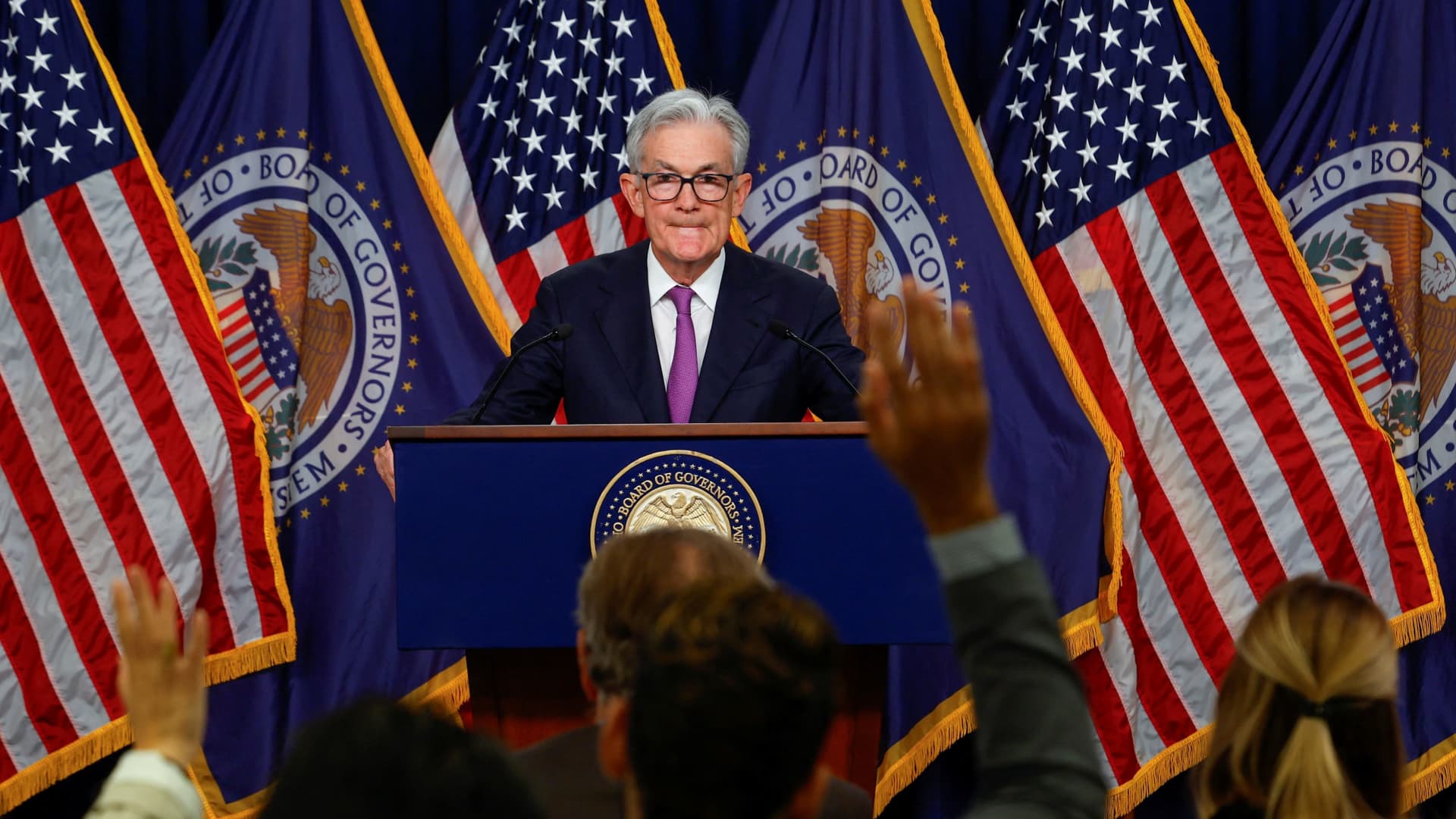
U.S. Federal Reserve Chairman Jerome Powell takes questions from reporters during a press conference after the release of the Fed policy decision to leave interest rates unchanged, at the Federal Reserve in Washington, U.S, September 20, 2023.
Evelyn Hockstein | Reuters
UBS expects the U.S. Federal Reserve to cut interest rates by as much as 275 basis points in 2024, almost four times the market consensus, as the world’s largest economy tips into recession.
In its 2024-2026 outlook for the U.S. economy, published Monday, the Swiss bank said despite economic resilience through 2023, many of the same headwinds and risks remain. Meanwhile, the bank’s economists suggested that “fewer of the supports for growth that enabled 2023 to overcome those obstacles will continue in 2024.”
UBS expects disinflation and rising unemployment to weaken economic output in 2024, leading the Federal Open Market Committee to cut rates “first to prevent the nominal funds rate from becoming increasingly restrictive as inflation falls, and later in the year to stem the economic weakening.”
Between March 2022 and July 2023, the FOMC enacted a run of 11 rate hikes to take the Fed funds rate from a target range of 0.25-0.5% to 5.25-5.5%.
The central bank has since paused at that level, prompting markets to mostly conclude that rates have peaked, and to begin speculating on the timing and scale of future cuts.
However, Fed Chairman Jerome Powell said last week that he was “not confident” the FOMC had yet done enough to return inflation sustainably to its 2% target.
UBS noted that despite the most aggressive rate-hiking cycle since the 1980s, real GDP expanded by 2.9% over the year to the end of the third quarter. However, yields have risen and stock markets have come under pressure since the September FOMC meeting. The bank believes this has renewed growth concerns and shows the economy is “not out of the woods yet.”
“The expansion bears the increasing weight of higher interest rates. Credit and lending standards appear to be tightening beyond simply repricing. Labor market income keeps being revised lower, on net, over time,” UBS highlighted.
“According to our estimates, spending in the economy looks elevated relative to income, pushed up by fiscal stimulus and maintained at that level by excess savings.”
The bank estimates that the upward pressure on growth from fiscal impetus in 2023 will fade next year, while household savings are “thinning out” and balance sheets look less robust.
“Furthermore, if the economy does not slow substantially, we doubt the FOMC restores price stability. 2023 outperformed because many of these risks failed to materialize. However, that does not mean they have been eliminated,” UBS said.
“In our view, the private sector looks less insulated from the FOMC’s rate hikes next year. Looking ahead, we expect substantially slower growth in 2024, a rising unemployment rate, and meaningful reductions in the federal funds rate, with the target range ending the year between 2.50% and 2.75%.”
UBS expects the economy to contract by half a percentage point in the middle of next year, with annual GDP growth dropping to just 0.3% in 2024 and unemployment rising to nearly 5% by the end of the year.
“With that added disinflationary impulse, we expect monetary policy easing next year to drive recovery in 2025, pushing GDP growth back up to roughly 2-1/2%, limiting the peak in the unemployment rate to 5.2% in early 2025. We forecast some slowing in 2026, in part due to projected fiscal consolidation,” the bank’s economists said.
Worst credit impulse since the financial crisis
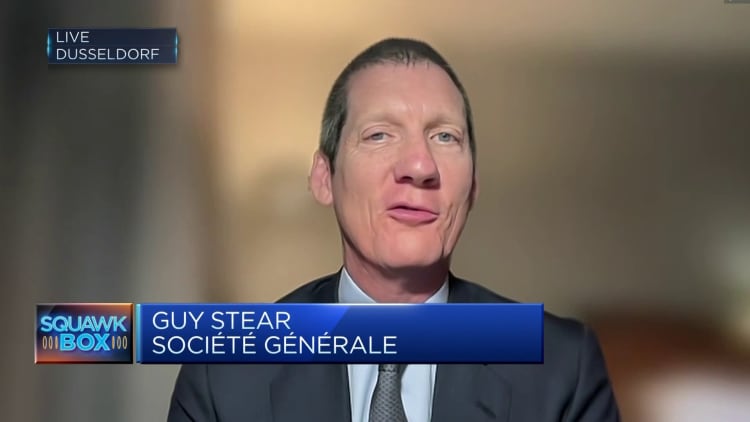
Arend Kapteyn, UBS global head of economics and strategy research, told CNBC on Tuesday that the starting conditions are “much worse now than 12 months ago,” particularly in the form of the “historically large” amount of credit that is being withdrawn from the U.S. economy.
“The credit impulse is now at its worst level since the global financial crisis — we think we’re seeing that in the data. You’ve got margin compression in the U.S. which is a good precursor to layoffs, so U.S. margins are under more pressure for the economy as a whole than in Europe, for instance, which is surprising,” he told CNBC’s Joumanna Bercetche on the sidelines of the UBS European Conference.
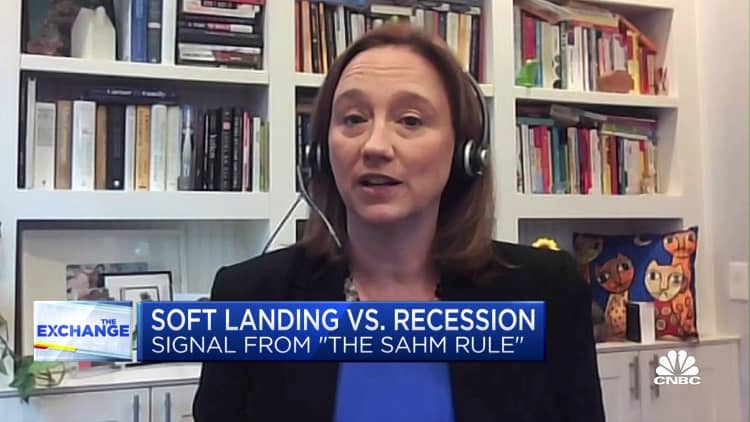
Meanwhile, private payrolls ex-health care are growing at close to zero and some of the 2023 fiscal stimulus is rolling off, Kapteyn noted, also reiterating the “massive gap” between real incomes and spending that means there is “much more scope for that spending to fall down towards those income levels.”
“The counter that people then have is they say ‘well why are income levels not going up, because inflation is falling, real disposable incomes should be improving?’ But in the U.S., debt service for households is now increasing faster than real income growth, so we basically think there is enough there to have a few negative quarters mid-next year,” Kapteyn argued.
A recession is characterized in many economies as two consecutive quarters of contraction in real GDP. In the U.S., the National Bureau of Economic Research (NBER) Business Cycle Dating Committee defines a recession as “a significant decline in economic activity that is spread across the economy and that lasts more than a few months.” This takes into account a holistic assessment of the labor market, consumer and business spending, industrial production and incomes.
Goldman ‘pretty confident’ in the U.S. growth outlook
The UBS outlook on both rates and growth is well below the market consensus. Goldman Sachs projects the U.S. economy will expand by 2.1% in 2024, outpacing other developed markets.
Kamakshya Trivedi, head of global FX, rates and EM strategy at Goldman Sachs, told CNBC on Monday that the Wall Street giant was “pretty confident” in the U.S. growth outlook.
“Real income growth looks to be pretty firm and we think that will continue to be the case. The global industrial cycle which was going through a pretty soft patch this year, we think, is showing some signs of bottoming out, including in parts of Asia, so we feel pretty confident about that,” he told CNBC’s “Squawk Box Europe.”
Trivedi added that with inflation returning gradually to target, monetary policy may become a bit more accommodative, pointing to some recent dovish comments from Fed officials.
“I think that combination of things — the lessening drag from policy, stronger industrial cycle and real income growth — makes us pretty confident that the Fed can stay on hold at this plateau,” he concluded.