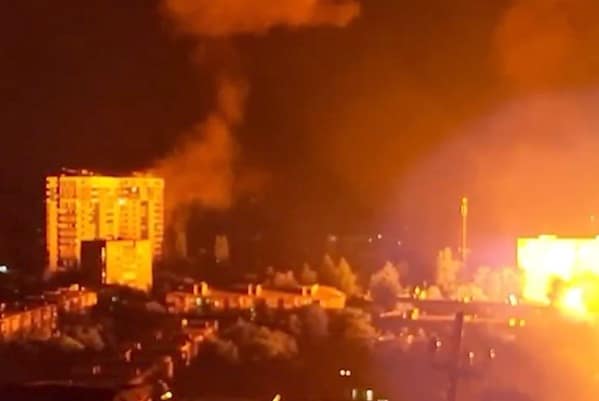
Last night’s Russian missile and drone attacks were not just another grim entry in Ukraine’s daily ledger of destruction.
They were part of a relentless aerial campaign in which Moscow launched dozens of missiles and hundreds of drones against Ukrainian cities and infrastructure, even as Ukraine’s air defences shot the majority down.
In similar recent multi-vector strikes, Russia has deployed upwards of 70 missiles and more than 400 attack drones in a single night — a tactic designed purely to overwhelm air defences and terrorise population centres.
The human toll has been rising. According to research from Action on Armed Violence, civilian harm from explosive violence in Ukraine increased by 26% in 2025 compared with the previous year, with 2,248 civilians killed and 12,493 injured, and the average number of civilians killed or wounded per incident rising by more than a third.
These figures, drawn from verified English-language reporting on explosive violence across the conflict, are stark reminders that Russian strikes continue to inflict suffering far from any frontline, according to, Action on Armed Violence.
Yet the strategic picture on the ground tells a different story. Despite this sustained pressure, Ukraine has not only held the line — it has begun to push back. Ukrainian forces recently recaptured over 200 square kilometres of territory, marking some of the fastest battlefield gains since mid-2023. Kyiv’s forces have also struck deep inside Russian-controlled areas and even into Russia itself, with drone operations reportedly reaching critical infrastructure such as oil refineries over 1,000 kilometres from the front.
Last week, Ukraine achieved one of its greatest successes on the battlefield in the last 2.5 years, — AFP
The agency analyzed data from the American Institute for the Study of War (ISW) and concluded that from Wednesday to Sunday last week, the Ukrainian military managed to… pic.twitter.com/ik59ZPSUQM
— Shaun Pinner (@olddog100ua) February 17, 2026
Ukraine’s evolving capabilities are evident beyond territorial shifts. Kyiv’s forces have successfully degraded Russian logistics by targeting ammunition depots, radar installations, air-defence nodes, and other support systems. Independent open-source assessments suggest Russia has suffered substantial equipment attrition, with thousands of armoured vehicles, artillery systems, and aircraft lost since the invasion began.
All of this matters because it directly contradicts the increasingly vocal political pressure from parts of the West that treat Moscow’s offensive as if it were winning. At the same moment Russian bombs were falling across Ukraine, Donald Trump again publicly urged Volodymyr Zelensky to “take Russia’s deal” — a formulation that implicitly treats the Kremlin’s territorial demands as bargaining chips. That appeal does not come from ignorance of the battlefield, but from a broader political calculus that reframes stalemate as Ukrainian failure rather than Russian limitation.
Trump: “Ukraine better come to the table fast.” pic.twitter.com/oawPn6p4C1
— Republicans against Trump (@RpsAgainstTrump) February 17, 2026
This pressure is now being amplified by political signalling in Central Europe. Marco Rubio’s recent trip did not stop at Budapest alone, but also included Slovakia, two governments that have repeatedly taken Russia-friendly positions and remain heavily reliant on cheap Russian energy. In both capitals, the messaging was read less as reassurance to allies and more as political accommodation, at a moment when Viktor Orbán, trailing in the polls and facing elections only months away, has once again turned Ukraine and Brussels into convenient campaign targets.
The implications are profound. When political figures in both Washington and parts of Central Europe start treating Ukrainian resistance as a liability rather than a defensive necessity, the burden of proof shifts onto Kyiv. Increasingly, whenever Ukraine regains momentum on the battlefield, political pressure seems to arrive to blunt it. Ukraine is being asked to trade a military stalemate, one in which it has demonstrated growing tactical success, for a political deal that rewards aggression and leaves borders insecure.
This is not a normal moment of negotiation. It is a two-front assault: Russian missiles overhead and Western political pressure — particularly from the United States — reframing peace as concession. For Europe’s security order, the real danger is not that Ukraine might be pushed into a deal, but that we begin to accept the idea that battlefield reality and diplomatic resolve can be overridden by political convenience.
That would amount to a deeper, more permanent defeat than the loss of any single stretch of territory.