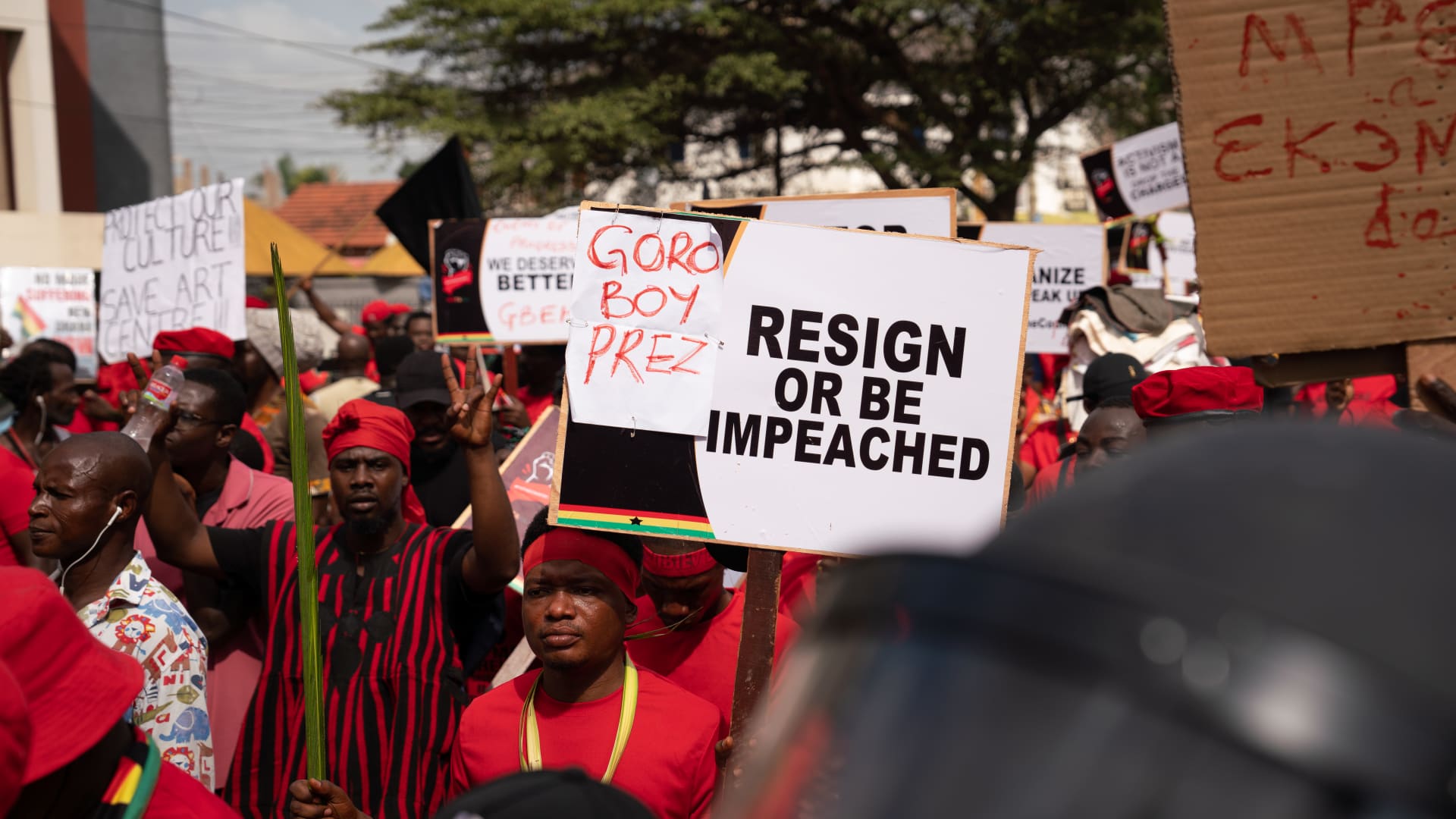
ACCRA, Ghana – Nov. 5, 2022: Ghanaians march during the ‘Ku Me Preko’ demonstration to protest against the soaring cost of living, aggravated since the Russian invasion of Ukraine. Some expressed opposition to the government’s pursuit of IMF assistance.
Ernest Ankomah/Getty Images
Leaders of several global financial bodies warned that rising interest rates are increasing pressure on low-income developing countries, around 60% of which are now in or at high risk of debt distress.
Public debt burdens in developing countries have been exacerbated in recent years by back-to-back global crises, with Russia’s invasion of Ukraine coming on the heels of the Covid-19 pandemic, while many heavily-indebted nations are also dealing with idiosyncratic pressures from climate events or conflict.
Major central banks around the world have tightened monetary policy aggressively over the past year in order to rein in soaring inflation. A lot of the debt accrued by low-income countries is coming due over the next couple of years, however, and rising interest rates mean these countries will find it increasingly difficult to meet their repayments.
The International Monetary Fund and the World Bank have established a host of relief measures in recent years, including the IMF-World Bank Debt Sustainability Framework, designed to guide the borrowing of low-income countries in a way that ensures stability in public finances.
Meanwhile the G-20 Common Framework, an initiative endorsed by the Paris Club — the group of officials from major lending countries tasked with finding solutions for debtor countries — was established in late 2020 to offer additional support in the form of grants to countries with unsustainable debt.
Ghana in January became the fourth country to seek debt treatment under the Common Framework, alongside Chad, Ethiopia and Zambia.
Yet the implementation, in practical terms, has not been smooth. Zambia, which became the first African country to default in 2020 after the onset of the pandemic, complained earlier this month that it was being “punished” in the debt restructuring process because its two main creditors, international bondholders and China, had failed to reach an agreement.
The IMF said earlier this month that the next instalment of Zambia’s $1.3 billion rescue loan was contingent on a debt restructuring agreement being reached.
Despite the provisions already in place, World Bank Senior Managing Director Axel van Trotsenburg told CNBC last week that with interest rates still rising and global growth slowing, more collaborative efforts from international bodies and developed economies would be needed.
“I think we should be worried. World economic growth is relatively weak and that has its implications, the increased interest rate means that a lot of capital has flowed out of developing countries — this is badly needed for investment, so many of the developing countries are under stress,” he told CNBC’s Joumanna Bercetche at the IMF Spring Meetings in Washington, D.C.
High interest rates in developed nations like the U.S. lead many investors to flock back to dollar-denominated assets, curbing their foreign investments.
“Particularly the poorest countries are bearing the brunt of it because they have in the first place a hard time to attract capital, and they have also to deal with other crises from conflict to climate, so this is a tough time,” van Trotsenburg said.
As such, van Trotsenburg called for “renewed solidarity with developing countries” from international bodies and major economies not just in the form of words, but with increased resources.
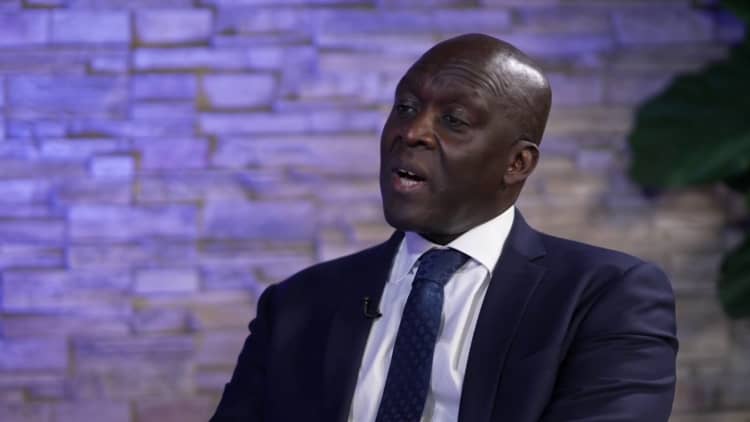
This was echoed by Makhtar Diop, managing director of the International Finance Corporation (IFC), a member of the World Bank Group and the largest global development institution devoted to the private sector in developing nations.
Addressing concerns about the impact of interest rate increases on financial stability and debt sustainability in the developing world, Diop said debt distress was “one of the main risks” that the global economy faces in the short term, especially as much of the at-risk debt is coming to maturity imminently.
“That’s actually something that we raised a decade ago when we saw a rapid rise in the indebtedness levels of low-income countries. We warned them by saying to them that the conditions at which this debt might be paid and refinanced in the future might be worse conditions, and will affect the sustainability of their economies,” Diop explained.
“A lot of bullet payments, as we call them, occurred eight years after the loans were made, and we need to address that situation.”
A bullet repayment refers to an entire outstanding loan amount being met with a single lump sum payment, usually at maturity.
Diop said establishing a firm path toward economic growth in developing economies would enable them to generate investment and stand a better chance of meeting future loan obligations.
He also suggested that institutions such as the Paris Club should include some of the borrowers in question, rather than just the world’s biggest lenders, in order to bring debtors and creditors into the same conversation and reach more workable solutions.
A third problem that must be addressed in order to return distressed countries to debt sustainability is the “currency mismatch,” he added.
“A lot of the debt was in dollar when countries are generating their income in local currency, so deepening the capital markets will be very important for countries to be able to offset some of this long-term risk,” Diop said.
The IMF last week forecast that global growth will be around 3% five years from now — the lowest medium-term forecast in the D.C.-based organization’s World Economic Outlook for more than 30 years.
In the short term, the Fund expects global growth of 2.8% this year and 3% in 2024, slightly below its estimates published in January.
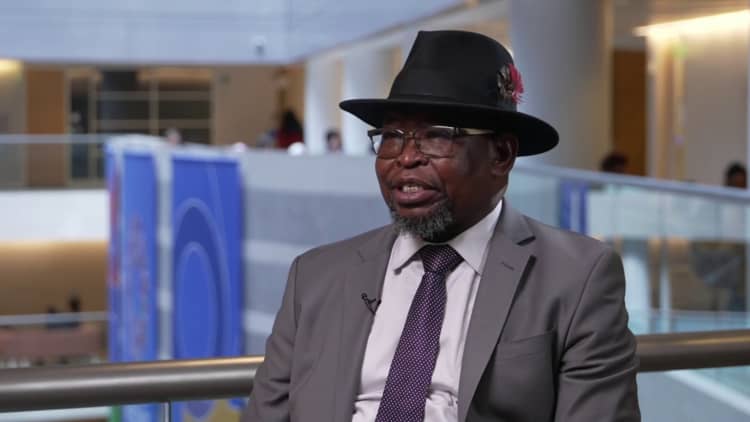
South African Finance Minister Enoch Godongwana also told CNBC that even as the most industrialized, technologically sophisticated and diversified economy in Africa, his country’s outsized exposure to global economic cycles was a potential concern.
“By way of example, if we look at the global financial crisis of 2007/2008, we were one of the heavily affected countries on the African continent, and lost one to 2 million jobs,” Godongwana said.
“Our connection to the global economy is deep, and therefore any changes in the global economy are likely to be massive.”