[ad_1]
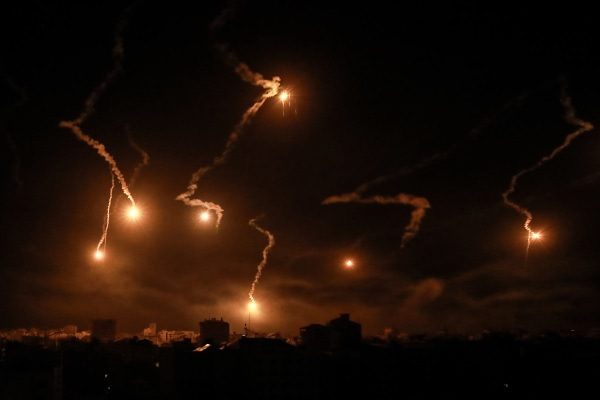
Israel’s Iron Dome anti-missile system intercepts rockets, as seen from Ashkelon, Israel, October 1, 2024
Amir Cohen | Reuters
Israel’s government has vowed a severe response to Iran’s unprecedented missile barrage into Tel Aviv, leaving the Middle East on edge as fears rise over a possible all-out war between the two long-time foes.
On Tuesday evening, Iran launched roughly 180 ballistic missiles at several sites across Israel, an attack Tehran said came in response to the Israeli assassination of Hezbollah chief Hassan Nasrallah the week prior.
Israeli authorities say there were no casualties as a result of the offensive, and that most of the strikes were intercepted. But the event marked a turning point in a series of escalatory tit-for-tat moves, as Tehran appeared adamant to re-set deterrence and prove to Israel that it could — and would — attack at a time of its choosing.
Markets are now braced for what could follow a likely Israeli retaliation against Iran. Defense stocks are rallying — and long-subdued oil prices may also be set for increases, as industry watchers now see a real threat to crude supplies.
As much as 4% of global oil supply is at risk as oil infrastructure in Iran — one of OPEC’s largest crude producers — could become a target for Israel.

Oil prices gained over 5% in the previous session following the missile strike, before tapering to a 2.5% climb. The December delivery contract of global benchmark Brent was trading at $75.37 per barrel at 10:30 a.m. in London, while front-month November U.S. West Texas Intermediate futures were up 2.68% to $71.70 per barrel.
“I think this focus might be on Israel, but the focus should really be on Iran, and whether there will be attacks on regional infrastructure. That really is the one event that we are looking for, and which could determine a more dangerous path for stock markets, for risk assets in general,” Frederique Carrier, head of investment strategy for the British Isles and Asia at RBC Wealth Management, told CNBC’s Capital Connection on Wednesday.
“We know, looking at the acts of war since the 1940s, that those which create an oil crisis [and] a prolonged increase in oil prices are the ones which have a long-lasting impact on stock markets.”
She added that so far, there is “no indication” of that.
Oil infrastructure ‘tempting targets for Israel’
Lewis Sage-Passant, an adjunct professor of intelligence at Sciences Po in Paris, described energy markets as jittery, as investors watch for Israel’s next moves.
“Iran depends on a handful of ‘chokepoint’ export terminals, such as Khark island, which will be tempting targets for Israel,” Sage-Passant said. “Energy sector teams seem nervous about an escalating tit-for-tat of strikes against regional infrastructure. Even without direct targeting, much of the world’s oil infrastructure sits under these missile’s flight paths, so naturally everyone is very nervous.”
Following the Tuesday attack, U.S. National Security Advisor Jake Sullivan warned of severe consequences for Iran, saying that the U.S. would staunchly support Israel. But Washington’s efforts to de-escalate and prevent a region-wide conflict have clearly failed, according to Roger Zakheim, a former U.S. deputy assistant defense secretary and director of the Ronald Reagan Institute in Washington.

Iran’s attack and the subsequent Israeli response “may result in impact on oil, energy markets, certainly aviation, and I think certainly the defense sector … Investments in missile defense and ammunition, those companies that manufacture and produce those systems, for sure are going to be impacted by what’s playing out in the Middle East,” he said.
Immediately following the Iranian strikes, U.S. defense stocks hit record highs. Their European counterparts also ticked higher on Wednesday morning on the rising conflict risks, with Saab and BAE Systems adding 2.2%. Thales and Rheinmetall both rose more than 1.3%.
“Israelis now will respond, not only in kind, but do what is necessary to restore deterrence,” Zakheim added.
Deterrence, or full-blown war?
Questions remain whether a strong Israeli response would restore deterrence or trigger further escalation from Iran and tip the nations into a full-blown war. In a statement following the country’s missile salvos, Iran’s Foreign Minister Abbas Araghchi said: “Our action is concluded unless the Israeli regime decides to invite further retaliation. In that scenario, our response will be stronger and more powerful.”
Aside from geographical choke points in the oil market, “there are plenty of facilities on [the] Iranian side and also [on the ] Israeli side that could all be targeted in terms of critical infrastructure,” Sara Vakhshouri, founder and president at SVB Energy, told CNBC’s Capital Connection on Wednesday.
“That infrastructure is all connected,” she said, stressing that the sheer size of Iran means “it is impossible to somehow secure all of it.”

Some market watchers are warning oil could hit $100 per barrel.
Vakhshouri expressed doubts over such a forecast, noting that geopolitical events often only affect oil prices temporarily. The extent and duration of any market impact “depends on where the destruction would be and how much oil is going to be taken off the market,” she said.
“Definitely, prices will have an upward trend. [But] the other thing is that the market is focusing on huge uncertainty on both sides … [whether] it’s the demand side or the geopolitical side.”
A longer-term issue underpinning oil prices is the broader global demand picture. Brent crude hit a 33-month low in mid-September and had hovered around $70 per barrel until Iran’s missile attack on Israel, based on slowing global demand and abundant supply, particularly from non-OPEC+ producers.
“So it’s very interesting moment now,” Vakhshouri said. “We have the prices being resilient due to the fear of low demand in the market, but also the geopolitical factor is real. Any side could really push the market, and we have seen just in the past few days, how the prices go up and down, depending on how the sentiments are triggered in the market.”
[ad_2]
Source link