Design is no longer confined to studios and showrooms, it’s now one of the most powerful tools in modern business. Across the UK, a new generation of designers is redefining how creativity shapes companies, brands, and industries. Walk into a co-working space in Shoreditch and you can tell which start-up understands design not as decoration, but as strategy.
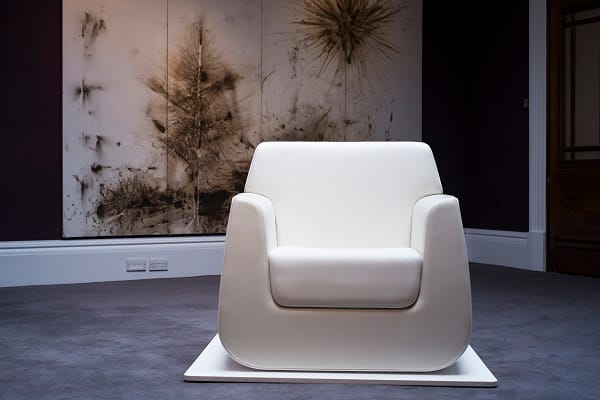
Cassina, the iconic Italian furniture brand, knows this all too well: their long-term collaboration with British duo Edward Barber and Jay Osgerby on the Tamburound Armchair, for example, shows how craftsmanship and concept can meet commercial intelligence. Among those leading this shift are designers who think like entrepreneurs, turning aesthetics into systems, and creativity into strategy.
1. Edward Barber & Jay Osgerby
In the world of high-end furniture, the duo Edward Barber & Jay Osgerby occupy a compelling space. Founded in London in 1996, their studio covers everything from industrial design to furniture, lighting and site-specific installations. Their work with Cassina positions them as designers who think beyond form: they think system, they think production, they think business. Notable projects include the Tobi-Ishi Table for B&B Italia and the Loop Writing Desk for Cappellini.
For companies, this means we now have case-studies of design firms that understand commercial dynamics: manufacturing, material sourcing, brand story, global distribution. When an enterprise aligns with designers like Barber and Osgerby, it’s not about making something pretty, it’s about making something profitable, repeatable, and meaningful. In today’s economy, that’s a powerful proposition. And their approach demonstrates how design thinking can move seamlessly between art, manufacturing, and management: exactly the kind of hybrid intelligence that defines modern creative business.
2. Jasper Morrison
Switch gears and you have Jasper Morrison, the British designer born in London in 1959, whose firm work has always emphasised practicality, simplicity and durability. A big part of the greatest designs of the B&B Italia’s Outdoor Collection is signed by him. His “super-normal” philosophy holds that objects shouldn’t shout, they should serve. For the business world, that approach is gold: efficiency, longevity and functionality matter more than temporary flash. Morrison’s minimal aesthetic has been adopted by organisations that don’t want their environment to distract, they want it to enable.
From office furniture to everyday products, the lesson here is clear: when design becomes infrastructure rather than decoration, it supports productivity and brand clarity. Businesses that adopt such design thinking reduce waste, increase user-satisfaction and ultimately deliver better value. Morrison reminds us that restraint can be revolutionary: in a world obsessed with novelty, simplicity itself becomes a competitive strategy.
3. Stella McCartney
Then there’s Stella McCartney: someone most people associate with fashion, but who has made serious moves into furniture design. Her collaboration with B&B Italia on the Camaleonda Sofa is a strong signal: sustainability and luxury can be aligned. The collection uses biodegradable yarn, circular materials, and is positioned at the intersection of design, ethics and commerce.
For business watchers, this is where design and values converge as strategic assets. McCartney’s shift shows that the luxury design market is no longer only about image, it’s also about purpose. When a company can integrate sustainable materials, transparent production, and design excellence, it sets itself apart. That distinction drives brand loyalty, premium pricing, and global relevance. Her collaboration with the Italian furniture brand is not just about home décor; it’s a statement on how ethics and aesthetics can merge into a viable business model.
4. Mark Krusin
Another London-based designer whose practice spans product, interior, and strategic consultancy. His work embracing both craft and global production is emblematic of how British-based design is not confined to UK showrooms: it’s embedded in international supply chains, brand strategy, and export growth. Among his collaborations, his work with Desalto for the Mini Clay Table exemplifies this balance between sculptural elegance and industrial precision.
From a business perspective, Krusin’s model shows how design firms can evolve into full-service partners: advising on product development, brand positioning, space planning, and even organisational culture. For companies in the UK or looking to the UK as a talent hub, that means access to design leadership that understands global scale and can deliver across markets. Krusin’s practice embodies a new model of design leadership: one that integrates creativity, consultancy, and commerce under a single vision.
What we can learn from Britain’s most visionary interior designers
What sets Britain’s leading interior designers apart isn’t just style, it’s mindset. They approach projects like entrepreneurs, building systems rather than isolated spaces. The most successful ones have mastered scalability: transforming bespoke craftsmanship into repeatable business models without losing integrity. Their studios operate more like strategic consultancies than creative ateliers, where design thinking drives brand positioning, client retention, and measurable growth.
They understand that storytelling, material sourcing, and sustainability aren’t decorative add-ons but levers of value creation. The real takeaway? In today’s creative economy, design isn’t just a department; it’s a business strategy, and those who treat it as such are the ones shaping the future of the industry.
Maybe the strongest takeaway is this: while spreadsheets keep the numbers in line, sketches keep the vision alive. In a world dominated by dashboards and KPIs, design reminds us there’s a human dimension that still matters. And perhaps that’s the best kind of business inspiration: knowing that you don’t just build a product, you design an ecosystem. Because the next great business revolution may not start with a spreadsheet, but with a sketch. From East London studios to Italian manufacturing floors, these British designers are quietly rewriting the rules… one pencil line at a time.